
Sea Buckthorn Oil Before and After: A Realistic Timeline
How long sea buckthorn takes to work on your skin and when taken by mouth, based on when clinical trials actually measured results, plus what tends to change, what doesn’t, and how to track it honestly.
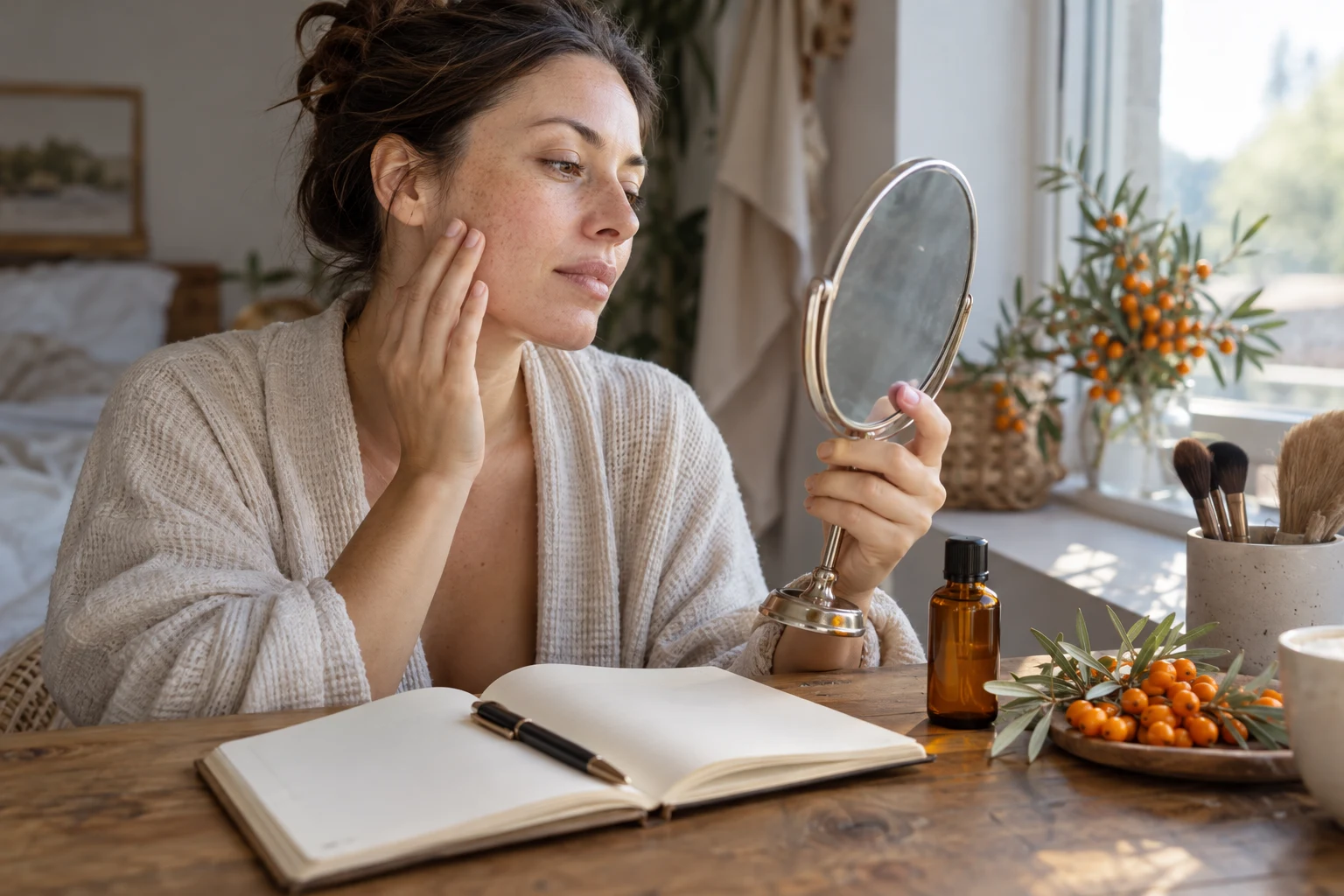
Expect gradual, modest changes over 6 to 12 weeks, not a dramatic overnight before-and-after. In trials, an oral omega-7 supplement improved skin hydration by week 6, a 5% sea buckthorn cream reached its biggest effect on skin tone at week 12, and sea buckthorn oil capsules for dry eyes and vaginal dryness were tested for 3 months. The softness you feel right after applying oil is real but temporary; judge lasting results at 12 weeks with same-light photos or a symptom log.
- Days 1–10: patch test first. The AAD suggests twice daily for 7–10 days before using a new product.
- Weeks 1–4: small measurable changes. A 5% extract cream lowered melanin readings 3.5% by week 1 and 7% by week 4.
- Week 6: oral omega-7 (500 mg/day) improved skin hydration and water loss vs placebo.
- Week 12 to month 3: where most trials found their results, including dry eyes (2 g/day) and vaginal dryness (3 g/day).
- What usually doesn’t change: wrinkles and elasticity didn’t beat placebo in the omega-7 trial.
- Track with same-light photos every 4 weeks or a 0–10 symptom score, and change one thing at a time.
What realistic results look like
Search “sea buckthorn oil before and after” and you’ll find glowing, poreless “after” photos. Most are taken in better light, with makeup, filters or a fresh glow from the oil sitting on the skin. Clinical trials tell a quieter story: sea buckthorn can improve hydration, barrier function and some symptoms over weeks to months, with changes you can measure but may not notice day to day.
Trials also show why you need a fair comparison. In a 4-month Finnish study of people with eczema, patients taking sea buckthorn pulp oil improved, but so did those taking a placebo of paraffin oil [7]. Skin and symptoms naturally go up and down with seasons, stress and other products. A single “after” photo can’t separate the oil from everything else.
Sea buckthorn oil results: the timeline at a glance
The chart below lines up when each study measured results. These are study checkpoints, not guarantees, and several studies used extracts or purified omega-7 rather than the oil in your bottle.
On your skin: week by week
| When | What you might notice | What studies measured |
|---|---|---|
| First use | Skin feels softer and looks dewier; pulp oil can leave an orange tint | Not a lasting change; the oil is sitting on the surface |
| Days 1–10 | Patch test period. Watch for redness, itching or swelling | AAD: apply twice daily for 7–10 days to a test spot [1] |
| Weeks 1–4 | Less tightness and flaking if your skin is dry | 5% extract cream: melanin readings −3.5% at week 1, −7.0% at week 4 [2] |
| Weeks 4–8 | Steadier hydration | A 5% extract emulsion improved hydration and water loss vs a plain cream across measurements from day 7 to day 84 [3] |
| Week 12 | Time for a fair before-and-after comparison | Melanin readings −16.35% vs +5.8% on the placebo side [2] |
| Months 6–12 | Dark spots, if they fade, take this long | AAD: spots a few shades darker take 6–12 months to fade once the cause stops [10] |
Two caveats. The skin studies above come from one research group in Pakistan, used 5% berry extracts in creams rather than pure oil, and were small: 25 people in the pigmentation study and 13 men in the hydration study [2][3]. They’re useful for timing, less so for promising a size of effect. For dark spots specifically, see sea buckthorn for dark spots; for breakouts, sea buckthorn oil for acne.
Taken by mouth: how long does sea buckthorn take to work?
Oral studies ran longer, and that’s the honest answer to “how long does it take”: plan on about 3 months.
| Goal | Dose and length | Result | Evidence |
|---|---|---|---|
| Skin hydration | 500 mg/day omega-7 (palmitoleic acid), 12 weeks, 90 women [4] | Hydration and water loss better than placebo at week 6 and week 12 | Early |
| Dry eyes | 2 g/day sea buckthorn oil, 3 months, 100 adults [5] | Smaller rise in tear osmolarity over winter; less redness and burning | Moderate |
| Vaginal dryness after menopause | 3 g/day oil, 3 months, 116 women [6] | About 3 times the odds of an improved vaginal lining vs placebo | Moderate |
| Eczema | 5 g/day seed or pulp oil, 4 months, 49 people [7] | Pulp oil group improved, but the placebo group did too | Unclear |
| Cholesterol (healthy adults) | 28 g/day berries, 3 months, 229 adults [8] | No change in cholesterol or triglycerides | No effect |
Note that the skin-hydration trial used purified omega-7, not sea buckthorn itself, and took one capsule after breakfast and one after dinner [4]. For timing tips, see the best time to take sea buckthorn, and for dosing, our dosage calculator.
Worked example: a 12-week dry-eye log
The Finnish dry-eye trial used 2 g of oil a day. With common 500 mg softgels, that’s 4 capsules a day, for example 2 with breakfast and 2 with dinner, for 12 weeks (about 336 capsules, or three 120-count bottles). A simple log might look like this:
| Week | Burning (0–10) | Redness (0–10) | Eye drops used per day |
|---|---|---|---|
| 0 (baseline) | |||
| 4 | |||
| 8 | |||
| 12 |
One detail from that trial is worth knowing: it ran from fall into winter, and tear osmolarity rose in both groups; it just rose less with sea buckthorn [5]. So “not getting worse during dry, heated-indoor months” may be what success looks like. More in sea buckthorn oil for dry eyes.
What changes and what doesn’t
| Likely to change (in studies) | Unlikely to change |
|---|---|
| Skin hydration and water loss [3][4] | Wrinkles, elasticity and roughness: no better than placebo at 12 weeks [4] |
| Dry-eye redness and burning [5] | Cholesterol in people with normal levels [8] |
| Vaginal lining after menopause [6] | Vaginal moisture and pH (no significant change) [6] |
| Melanin readings with an extract cream [2] | Deep or long-standing pigmentation within weeks [10] |
One “after” you don’t want: a man who ate large amounts of sea buckthorn for 6 months developed yellow skin, which appeared gradually over 3 months and was traced to the carotenoids [9]. Sticking to studied doses avoids it.
How to track your own before and after
- Pick one goal, such as dry cheeks, a dark spot or eye burning, and one product. Don’t start a retinoid and sea buckthorn in the same week.
- Take a baseline photo in the same spot, at the same time of day, facing the same window, with no makeup and the same camera distance. Repeat at weeks 4, 8 and 12.
- Score symptoms 0–10 weekly for things photos miss, like tightness, itch or eye burning.
- Note confounders: season changes, new medicines, travel, illness or a period.
- Decide at week 12. If you see no difference by then, a longer run is unlikely to change that.
Choosing a product? Compare cold-pressed vs CO2-extracted oil and our tested face oils.
When to stop or see a doctor
- Stop topical use if a test spot turns red, itchy or swollen; wash it off and don’t reuse it. See a dermatologist if a reaction is severe or doesn’t settle [1].
- Stop capsules and talk to your doctor if your skin turns yellow-orange or you have ongoing stomach upset.
- Check first if you take blood thinners, blood pressure or diabetes medicine, are pregnant or breastfeeding, or have surgery coming up (stop 2 weeks before). See side effects and interactions.
- Don’t wait 12 weeks on worsening eye pain, vision changes or a changing mole; get them checked.
Frequently asked questions
How long does sea buckthorn oil take to work on skin?
Small changes in hydration can show within a few weeks, but most studies measured their main results at 12 weeks. Give it about 3 months before judging.
How long does sea buckthorn take to work when taken by mouth?
Oral trials ran 6 weeks to 4 months. Omega-7 improved skin hydration by week 6, while dry eye and vaginal dryness trials measured results at 3 months.
What results can I expect from sea buckthorn oil?
Realistic results are better hydration, less dryness and, for some people, fewer dry-eye symptoms. In trials, wrinkles and skin elasticity did not improve more than with placebo.
Are sea buckthorn oil before and after photos reliable?
Often not. Lighting, makeup, filters and the temporary glow of oil on the skin can all exaggerate changes. Compare your own photos taken in the same light every 4 weeks.
Why am I not seeing results from sea buckthorn oil?
It may be too early, the goal may be one sea buckthorn has not been shown to help, such as wrinkles, or other factors like season and new products may be masking changes. If there is no difference at 12 weeks, it may not work for you.
Does sea buckthorn oil make skin glow right away?
The oil adds shine and softness as soon as you apply it, but that is a surface effect. Lasting changes in hydration took weeks in studies.
Should I stop sea buckthorn if my skin turns orange?
An orange tint from pulp oil on the skin washes off. Yellow-orange skin all over from taking a lot by mouth means you are taking too much; stop and talk to your doctor.
- American Academy of Dermatology. How to test skin care products. aad.org
- Khan BA, Akhtar N, Hussain I, Abbas KA, Rasul A. Whitening efficacy of plant extracts including Hippophae rhamnoides and Cassia fistula extracts on the skin of Asian patients with melasma. Postepy Dermatol Alergol. 2013;30(4):226-32. PubMed
- Khan BA, Akhtar N. Hippophae rhamnoides oil-in-water (O/W) emulsion improves barrier function in healthy human subjects. Pak J Pharm Sci. 2014;27(6):1919-22. PubMed
- Koh YG, Seok J, Park JW, et al. Efficacy and safety of oral palmitoleic acid supplementation for skin barrier improvement: a 12-week, randomized, double-blinded, placebo-controlled study. Heliyon. 2023;9(6):e16711. PubMed
- Larmo PS, Järvinen RL, Setälä NL, et al. Oral sea buckthorn oil attenuates tear film osmolarity and symptoms in individuals with dry eye. J Nutr. 2010;140(8):1462-8. PubMed
- Larmo PS, Yang B, Hyssälä J, Kallio HP, Erkkola R. Effects of sea buckthorn oil intake on vaginal atrophy in postmenopausal women: a randomized, double-blind, placebo-controlled study. Maturitas. 2014;79(3):316-21. PubMed
- Yang B, Kalimo KO, Mattila LM, et al. Effects of dietary supplementation with sea buckthorn (Hippophae rhamnoides) seed and pulp oils on atopic dermatitis. J Nutr Biochem. 1999;10(11):622-30. PubMed
- Larmo PS, Yang B, Hurme SA, et al. Effect of a low dose of sea buckthorn berries on circulating concentrations of cholesterol, triacylglycerols, and flavonols in healthy adults. Eur J Nutr. 2009;48(5):277-82. PubMed
- Grad SC, Muresan I, Dumitrascu DL. Generalized yellow skin caused by high intake of sea buckthorn. Forsch Komplementmed. 2012;19(3):153-6. PubMed
- American Academy of Dermatology. How to fade dark spots in darker skin tones. aad.org
This article is for general information only and is not medical advice. Talk to your doctor or pharmacist before starting any supplement, especially if you take medication, are pregnant or breastfeeding, or have a health condition.