
Sea Buckthorn Oil Stains: Skin Tint, Sheets & Clothes
Why the orange oil stains, whether the tint on your skin is permanent, and step-by-step methods for fresh and set-in stains on sheets, pillowcases, towels and clothes.
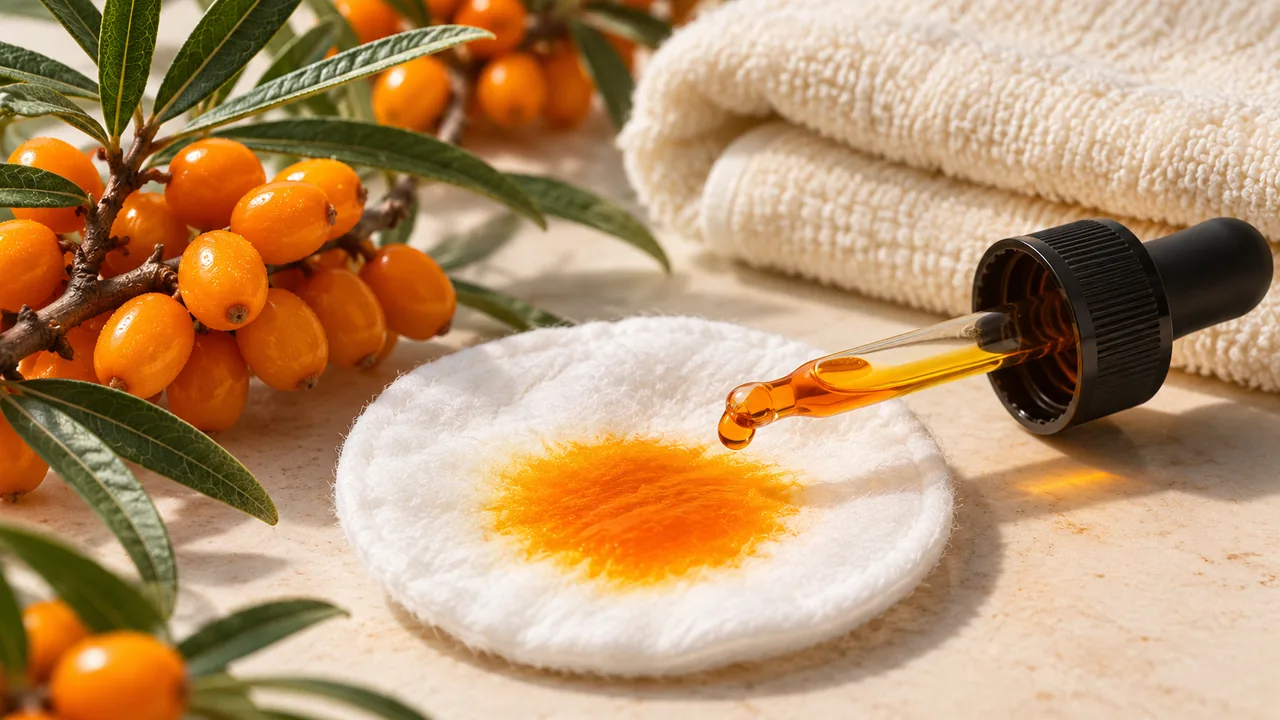
Yes, sea buckthorn oil stains, mainly the fruit (pulp) oil, which is packed with carotenoid pigments: about 3 mg per gram in one lab-analyzed oil. Pale seed oil barely stains. The tint on skin is not permanent and comes off with an oil cleanser. On sheets and clothes, degrease first (full-strength liquid detergent, hottest water the fabric allows), then lift the color with an oxygen bleach soak, and keep it out of the dryer until the orange is gone, because heat sets stains.
- Pulp oil stains; seed oil mostly doesn’t. The orange comes from carotenoids concentrated in the pulp.
- Skin tint is temporary. Carotenoids dissolve in oil, so use an oil cleanser first, then wash.
- Fabric stains are grease plus pigment. Degrease first, then soak in oxygen bleach.
- Never machine-dry a stained item. Heat sets stains, and oil-soaked laundry is a fire risk in dryers.
- Yellowed pillowcases often come from washing oily fabric in cold water.
- Dilute pulp oil to 1–2% and wait 30 minutes before bed, and staining mostly stops.
Why sea buckthorn oil stains (and seed oil barely does)
Pulp or fruit oil comes from the soft orange flesh of the berry; seed oil comes from the seeds. Unlike seed oil, pulp oil is high in carotenoids [1]. In a comparison of whole berry, pulp and seed, the pulp was rich in carotenoids while the seed was richer in vitamin E and plant sterols [3].
A cold-pressed fruit oil analyzed in Romania held 303 mg of carotenoids per 100 g, mostly zeaxanthin plus beta-carotene and lutein [2]. That’s about 3 mg of pigment per gram, or 14 mg in a teaspoon. Other fruit oils have been reported at up to about 2,000 mg per 100 g [2], which is why some bottles look almost blood-red.
Carotenoids dissolve in fat, not water, so the pigment rides with the oil into skin and fabric. On cloth you get a grease stain and a color stain at once, which laundry specialists call a combination stain [4].
| Product | Typical color | Stain risk |
|---|---|---|
| Fruit / pulp oil, CO2 fruit extract | Deep orange to red | High on skin, nails and fabric |
| Seed + pulp blends | Depends on the pulp share | Medium to high |
| Seed oil | Pale yellow to amber | Low; may leave an oil mark |
| Softgel capsules | Sealed | None unless one breaks |
Our guide to cold-pressed vs CO2-extracted oils explains how processing changes the product.
Does sea buckthorn oil stain skin? Is the tint permanent?
Yes, undiluted pulp oil leaves a yellow-orange cast, most visible on fair skin, around the hairline, and on fingertips and cuticles.
It is not permanent. The pigment sits in the oil film and the outermost layer of skin; most comes off with the right cleanser, and the rest fades as that layer sheds. If the tint seems to “build up” over a week, each night’s layer usually isn’t being fully removed in the morning.
Different problem: yellow skin from swallowing it. Yellow-orange palms and soles while taking sea buckthorn by mouth aren’t a stain but carotenoids building up from the inside. A 45-year-old man developed yellow skin after about 6 months of heavy sea buckthorn intake [7]. It’s harmless, but if the whites of your eyes are yellow too, it may be jaundice: contact a doctor [8].
How to get sea buckthorn tint off skin and nails
Carotenoids are fat-soluble, so fight oil with oil.
- Oil first. On dry skin, massage in a cleansing balm or a teaspoon of plain jojoba or sunflower oil for 30–60 seconds, then wipe off with a warm, damp washcloth.
- Follow with your usual gentle cleanser.
- Hands and nails: lather with dish soap and use a soft nail brush on the cuticles. On the nail plate, nail polish remover on a cotton pad often lifts what’s left.
- Skip harsh fixes. Scrubs irritate skin without removing much pigment, and lemon or lime juice plus sunlight can cause a blistering rash, as our DIY serum guide explains.
Prevention is easier: wash your hands right after applying, before the pigment settles into the cuticles.
How to get sea buckthorn oil out of sheets and clothes
These steps follow Texas A&M AgriLife Extension’s method for oil-based and combination stains, which warns that old stains may be impossible to remove, so act fast [4].
- Blot, don’t rub. For a big spill, sprinkle on cornstarch or talc, let it absorb, then brush it off. Test any remover on a hidden seam first [4].
- Degrease. Work full-strength heavy-duty liquid laundry detergent or a prewash spray into both sides of the fabric [4]. Grease-cutting dish soap works the same way. Let it sit several minutes.
- Wash in the hottest water safe for the fabric [4]. Cotton sheets and towels can usually take hot.
- Inspect while wet. If any orange remains, don’t dry it: heat sets stains [4].
- Lift the color with oxygen bleach. Soak in oxygen (“all-fabric”) bleach per the package, then rewash. It’s usually safe for all fabrics and colors except flame-retardant finishes [4].
- Air-dry. On white cotton, drying in direct sun can help fade leftover pigment, because carotenoids break down with light and oxygen [5]. Sunlight can also fade colors and yellow some white fabrics [4], so dry colored items in the shade and check whites after a few hours.
Oily towels and the dryer. Towels used with body or massage oil can hold a lot of it. The U.S. Consumer Product Safety Commission advises washing clothes soiled with cooking oils more than once and preferably hanging them to dry; if you use a dryer, choose the lowest heat with a cool-down cycle, and don’t leave dried items piled up, where they can ignite [6].
By fabric
| Fabric | Wash water | Bleach option | Drying |
|---|---|---|---|
| White cotton sheets, pillowcases, towels | Hot | Oxygen bleach; dilute chlorine as a last resort | Line-dry, sun is fine |
| Colored cotton and linen | Hottest the label allows | Oxygen bleach after a colorfast test | Line-dry in shade |
| Spandex, silk, wool | Per label | No chlorine bleach [4] | Air-dry flat |
| Dry-clean only | Take it to a cleaner soon and tell them it’s a plant oil with orange pigment [4] | ||
Set-in and yellowed stains
An orange spot that went through the dryer, or a dingy yellow pillowcase, is harder but often fixable. Some methods need repeating several times [4].
- Loosen it with more oil. The extension method for dry-type stains is to lubricate them with mineral or coconut oil to loosen them [4]. Work in a few drops of mineral oil.
- Degrease and wash hot, as above.
- Soak in oxygen bleach as long as the package allows, then rewash. Repeat while the orange keeps fading.
- White or colorfast cotton only: the last resort is a 15-minute soak in dilute chlorine bleach [4]. Never combine bleach with ammonia.
Whole pillowcase yellow? That’s usually buildup. Texas A&M notes yellowing can come from too little or too much detergent, or from washing oily soil in cold water. Their fix: a wash in the hottest safe water with a cup of water conditioner instead of detergent, then a rewash with detergent and a fabric-safe bleach. Yellowing on silk, wool or spandex is often permanent [4]. Enzyme detergents target protein stains like sweat [4]; they help with body soil, but the oil still needs a degreaser and the orange needs bleach.
Why foundation can look orange, green or patchy on top
If you use sea buckthorn oil in the morning, two things can throw off your foundation:
- The oil breaks up the makeup. A layer of oil under foundation thins its film, so it slides, separates and can look patchy or darker by midday.
- The pigment shifts the shade. An orange-yellow film under a warm foundation pushes it toward orange. Under a cool or ash-toned foundation, the mix of yellow with blue-gray tones can read sallow or faintly greenish.
The fix: save pulp oil for night. In the morning, use seed oil or one drop of diluted serum in moisturizer, wait 10–15 minutes, blot, then apply foundation.
Dilutions and a pillowcase routine that prevent tint
Most staining comes from using pulp oil straight. Dilute it:
- Pulp or CO2 fruit oil: 1–2%, or 6–12 drops in a 1 oz (30 mL) bottle topped up with jojoba or sunflower oil.
- Seed oil: about 5% (30 drops per ounce); it rarely tints.
Our DIY serum guide has full drop charts. If you’re acne-prone, read sea buckthorn oil for acne first; ready-made blends are in our best sea buckthorn oils for face list.
A no-stain night routine
| When | Step |
|---|---|
| 9:30 pm | Cleanse. Press in 3–4 drops of a 2% pulp-oil serum, or mix 1 drop of pulp oil into night cream. Wash your hands. |
| 10:00 pm | After 30 minutes, sleep on a dark or dedicated pillowcase, or lay a cotton towel over it. |
| Morning | Oil cleanser or balm first, then your regular cleanser. |
| Weekly | Pretreat orange spots, wash pillowcases hot if the fabric allows, line-dry. |
The 30-minute wait comes from our overnight oil guide. Capsules avoid topical staining entirely. Staining is cosmetic; for redness or itching, see sea buckthorn side effects.
Frequently asked questions
Does sea buckthorn oil stain skin?
Fruit (pulp) oil and deep-orange CO2 extracts leave a yellow-orange tint because they are rich in carotenoids. Seed oil rarely tints. Diluting pulp oil to 1 to 2 percent mostly prevents it.
Is the orange tint from sea buckthorn oil permanent?
No. It sits on the skin surface and comes off with an oil cleanser followed by your usual face wash. Any trace left fades as the outer skin layer sheds.
How do I get sea buckthorn oil out of sheets?
Blot, work full-strength liquid laundry detergent or dish soap into the stain, and wash in the hottest water the fabric allows. If orange remains, soak in oxygen bleach and rewash before drying.
Can I put sea buckthorn oil stained clothes in the dryer?
Not until the stain is gone, because heat sets stains. The CPSC also advises washing oil-soaked fabric more than once and hanging it to dry, because oily laundry can catch fire.
Does sea buckthorn seed oil stain?
Very little. Seed oil is pale and contains far less pigment than pulp oil, though any oil can leave a grease mark on fabric.
Can sea buckthorn oil cause yellow skin all over?
Yellow-orange palms and soles from taking sea buckthorn oil by mouth come from carotenoid buildup, not a stain. It is harmless and fades after you cut back, but if the whites of your eyes are yellow, contact a doctor.
- Zielińska A, Nowak I. Abundance of active ingredients in sea-buckthorn oil. Lipids Health Dis. 2017;16(1):95. PubMed
- Tudor C, Bohn T, Iddir M, et al. Sea buckthorn oil as a valuable source of bioaccessible xanthophylls. Nutrients. 2019;12(1):76. PubMed
- Shi L, Zheng L, Zhao C, Jin Q, Wang X. Chemical composition and antioxidant capacity of extracts from the whole berry, pulp and seed of Hippophae rhamnoides ssp. yunnanensis. Nat Prod Res. 2019;33(24):3596-3600. PubMed
- Texas A&M AgriLife Extension Service. Removing stains from washable fabrics. PDF
- Boon CS, McClements DJ, Weiss J, Decker EA. Factors influencing the chemical stability of carotenoids in foods. Crit Rev Food Sci Nutr. 2010;50(6):515-32. PubMed
- U.S. Consumer Product Safety Commission. Overheated clothes dryers can cause fires (Publication 5022). PDF
- Grad SC, Muresan I, Dumitrascu DL. Generalized yellow skin caused by high intake of sea buckthorn. Forsch Komplementmed. 2012;19(3):153-6. PubMed
- MedlinePlus Medical Encyclopedia. Jaundice. U.S. National Library of Medicine. MedlinePlus
This article is for general information only and is not medical advice. Test any stain remover on a hidden area first and follow product labels. If your skin or the whites of your eyes turn yellow without an obvious cause, talk to your doctor.