
Is My Sea Buckthorn Oil Real? Smell, Color & Label Checks
What a normal bottle looks and smells like, how to spot rancid oil, why it clouds in the fridge, the label red flags to look for on Amazon, and how to check a USDA Organic claim yourself.
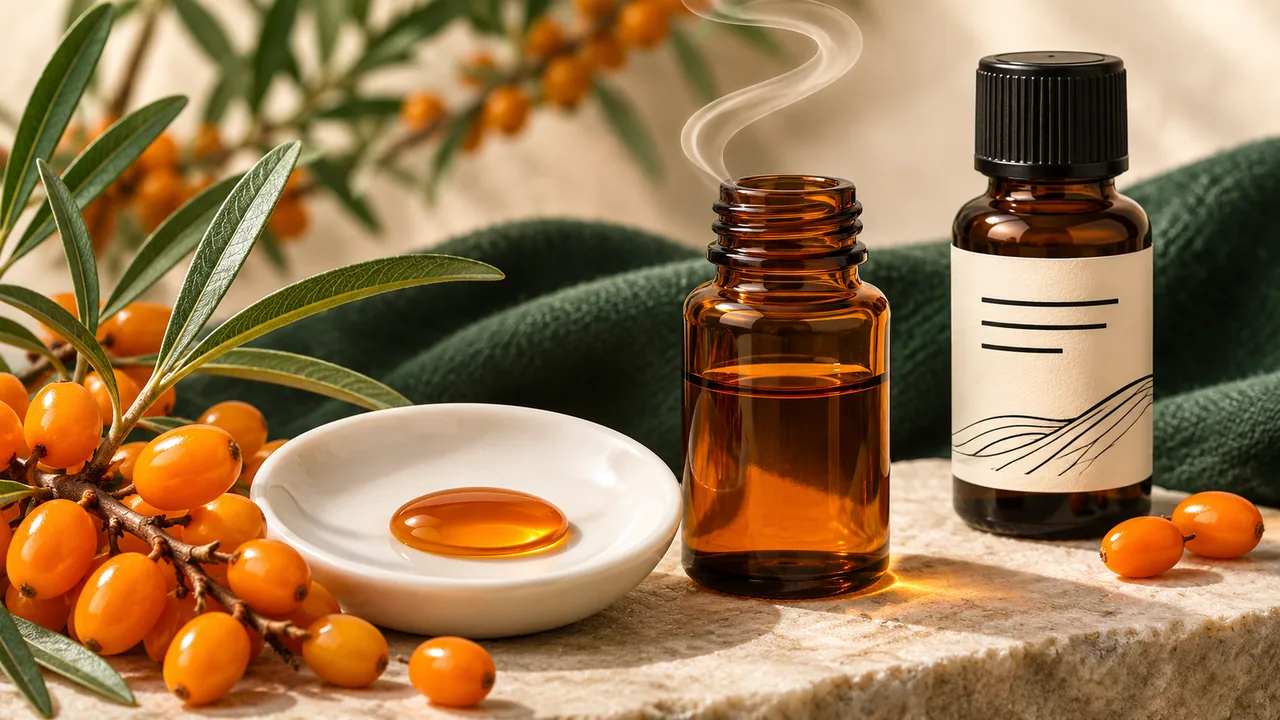
You can’t prove sea buckthorn oil is genuine at home, but a 5-minute check catches most problems. Pulp (fruit) oil should be deep orange-red (about 100–500 mg of carotenoids per kg); seed oil is pale gold (1–5 mg/kg). A strong earthy, fruity smell is normal; a stale, bitter or cardboard-like smell means it has oxidized. The label should name Hippophae rhamnoides, the plant part, a lot number and a date, and any USDA Organic claim can be checked in the free USDA Organic Integrity Database.
- Color follows the plant part. A pale “fruit oil” or a bright orange “seed oil” deserves questions.
- Earthy or musky is normal; stale, bitter or cardboard-like is oxidation. Clearly fishy is not normal for a plant oil.
- Clouding in the fridge is normal for pulp oil, which is rich in palmitic acid (melts at about 145°F).
- Label red flags: no plant part, sea buckthorn near the end of the ingredient list, no lot number, and “organic” with no certifier named.
- The real proof is a fatty acid test: pulp oil has roughly 12–39% palmitoleic acid (omega-7); seed oil has almost none.
- “Comedogenic rating 0” is not a test result. No published pore-clogging test of this oil exists.
Sea buckthorn oil smell: what’s normal
A common complaint in skincare forums is that a new bottle “smells like dirt” or hay, and buyers worry it is fake. Usually it is neither. Unrefined sea buckthorn oil, especially pulp oil, has a strong smell of its own, and there is no single correct one: fruit oils from three regions of China contained 52, 51 and 37 different aroma compounds depending on where the berries grew [1].
| Smell | What it usually means |
|---|---|
| Earthy, musky, fruity, hay-like | Normal for unrefined pulp oil. Seed oil is milder |
| Almost no smell | Possibly refined or heavily diluted. Check the label and color |
| Stale, bitter, cardboard-like | Oxidation (rancidity) |
| Clearly fishy | Not expected. Contact the seller |
Why isn’t fishy normal? In a lab study, oxidized EPA and DHA (the fish-oil omega-3s) produced the typical fishy odor, but oxidized ALA, the plant omega-3 in sea buckthorn seed oil, did not produce an unpleasant smell [2].
Is my sea buckthorn oil rancid?
Rancidity is oxidation, and its breakdown products smell rancid and cardboard-like; light and trace metals speed it up [3]. Food scientists describe sea buckthorn fruit oil as highly prone to oxidation during storage, mainly through its linoleic acid [4], and seed oil is vulnerable because it is rich in ALA [5].
- Smell test: sniff a new bottle the day you open it. If it later turns sharper, bitter or stale, it has changed.
- Look: heat, sunlight and air change the color and texture of cosmetics [6]. Pulp oil that fades from orange-red to dull yellow has lost carotenoids.
- Feel: a sticky, varnish-like film on the bottle neck is old, oxidized oil.
Storage: cap on tight, dark glass, away from the stove, sunny windows and the shower shelf, and never in a hot car [6]. Refrigerating opened seed oil is reasonable.
Shelf life once opened: no study has tested opened bottles at home, and US law doesn’t require cosmetics to carry expiration dates at all; shelf life is set by the manufacturer [6]. Treat the best-by date as your outer limit, and buy a size you’ll finish in 2–3 months. For a few drops a night, the smallest bottle (often 0.5 oz, or 15 mL) is usually plenty. That is our suggestion, not a tested shelf life.
What color should it be?
Color is your most useful clue. It comes from carotenoids, which sit in the fruit flesh, not the seed: pulp oil holds about 100–500 mg/kg and seed oil only 1–5 mg/kg [5]. In one analyzed pulp oil, the main pigment was zeaxanthin bound to palmitic acid, with beta-carotene alongside [9].
Seed oil is mostly polyunsaturated: linoleic plus alpha-linolenic acid make up about 70% of its fatty acids, and palmitoleic acid is practically absent [7]. Seed oil can be pressed or extracted with supercritical CO2 [10], and the method doesn’t turn a seed oil orange; see our cold-pressed vs CO2 guide.
Mismatches to question: a pale yellow “fruit oil” (diluted, or mislabeled seed oil) or a bright orange “seed oil” (likely a blend). Both are worth an email to the seller.
Why it clouds in the fridge
Orange sludge at the bottom of the bottle, or a buttery, cloudy look after a cold night, is usually normal for pulp oil. Pulp oil is heavy in saturated palmitic acid (33% in one Finnish pulp oil [8], 49% in another sample [9]), and pure palmitic acid melts at about 63°C (145°F) [11], so its fats crystallize first in the cold. Palmitoleic acid (omega-7) is not the culprit: on its own it stays liquid to about −0.1°C (31.8°F) [12]. In real oil these acids are bound into larger fat molecules, so exact clouding points differ, but the principle holds.
Seed oil, being mostly polyunsaturated, usually stays clear. To re-liquefy pulp oil, warm the closed bottle in your hand or a cup of warm (not hot) water and shake gently.
Fake sea buckthorn oil: label red flags
“Fake” usually means a little sea buckthorn in a lot of cheaper oil, the wrong plant part, or old stock.
| Red flag | Why it matters |
|---|---|
| Sea buckthorn near the end of the list | Cosmetic ingredients are listed in descending order of amount, and those at 1% or less may follow in any order [13]. Last place usually means a minor amount |
| No plant part | Seed and pulp oil are different products. Supplements must name the plant part of a botanical [14]; good skincare labels say Fruit Oil or Seed Oil |
| No Latin name | Cosmetic labels use standardized ingredient names [13], which for this plant include Hippophae rhamnoides. Supplements may omit it when a standard common name is used [14], so it’s a soft flag |
| No lot number or date | Not legally required on cosmetics [6], but without a lot number you can’t match a complaint, recall or lab report to your bottle |
| “Organic” with no certifier | “Organic” and “100% organic” products must say “Certified organic by” and name the certifier [17] |
| “High omega-7 seed oil” | Seed oil has practically no palmitoleic acid [7] |
The berry math behind a “too cheap” price
Fresh berries are only about 3.5% oil, and seeds about 11%, in the European subspecies [7]; seeds range from 8–20% oil and dried pulp about 20–25% [15]. One fluid ounce of oil weighs roughly 27 g, so at 3.5% it takes about 1.7 lb (780 g) of fresh berries per ounce, assuming every drop is recovered, which never happens. Compare price per ounce across products that name the plant part and a certifier; one that costs a small fraction of all of them deserves a closer look.
The strongest proof is a certificate of analysis (COA) for your lot showing the fatty acid profile: pulp oil should show palmitoleic acid somewhere in the 12–39% range, and seed oil about 70% linoleic plus alpha-linolenic acid [7]. Good sellers send one on request. To shop, see where to buy sea buckthorn in the USA, our face oil picks and, for softgels, the capsule guide.
How to check a USDA Organic claim
Cosmetics made from agricultural ingredients, such as a plant oil, can be USDA certified and use the same label categories as food [19]. “100% organic” and “organic” (95%+) may show the USDA seal; “made with organic” (70%+) may not show the seal anywhere [16]. European and private eco logos can be legitimate, but they are not USDA certification [19].
- Find “Certified organic by” on the back label, and note the certifier and the handler or distributor named [17].
- Search that company in the free USDA Organic Integrity Database [18]. The Amazon brand name may not be the certified operation; try the manufacturer or distributor.
- Confirm the status shows certified (not surrendered, suspended or revoked) and the certifier matches the label.
- Can’t find it? Ask the seller for their organic certificate.
A seal covers farming and handling, not freshness or concentration. A certified oil can still be rancid, the wrong plant part, or diluted with another organic oil. Use it alongside the color, smell and ingredient checks.
The 5-minute at-home check
| Step | Normal | Red flag |
|---|---|---|
| 1. Ingredient list | Hippophae rhamnoides + plant part, first or only ingredient | Near the end; no plant part |
| 2. Lot, date, certifier | Lot number, best-by date, “Certified organic by…” if organic | None of these; a seal on a “made with organic” product |
| 3. Drop on a white paper towel | Pulp oil: strong orange mark. Seed oil: pale yellow spot | Color doesn’t match the label |
| 4. Smell | Earthy, musky, fruity | Stale, bitter, cardboard-like or fishy |
| 5. Database search | Operation found, status certified | Not found, and no certificate offered |
Only a lab test proves authenticity. If your oil passes, our DIY serum guide gives dilutions, and the omega-7 guide explains what palmitoleic acid does.
Myth: “comedogenic rating 0”
Listings that promise “0 on the comedogenic scale” are quoting an estimate: we found no published pore-clogging test of sea buckthorn oil. The rabbit-ear test behind most rating charts was criticized as early as 1982 for poor correlation with human skin [20], and a 2006 human study found that finished products containing supposedly comedogenic ingredients weren’t necessarily comedogenic [21]. See sea buckthorn oil for acne for how to test it on breakout-prone skin.
Frequently asked questions
Is it normal for sea buckthorn oil to smell earthy?
Yes. Unrefined pulp oil smells strongly earthy, musky or fruity, and aroma varies with where the berries grew. A stale, bitter or cardboard-like smell means it has oxidized.
How can I tell if sea buckthorn oil is real?
Check that the label names Hippophae rhamnoides and the plant part, that sea buckthorn is the first or only ingredient, and that the color fits: deep orange-red for pulp oil, pale gold for seed oil. Only a lab fatty acid test proves it.
How do I know if sea buckthorn oil is rancid?
A sharper, bitter or stale smell than when you opened it, faded color, or a sticky film on the bottle neck all point to oxidation. Throw it out.
What color should sea buckthorn oil be?
Pulp or fruit oil is deep orange-red, with about 100 to 500 mg of carotenoids per kg. Seed oil is pale yellow-gold, with 1 to 5 mg/kg. Blends fall in between.
Why did my sea buckthorn oil go cloudy in the fridge?
Pulp oil is rich in saturated palmitic acid, which crystallizes in the cold. It is harmless; warm the closed bottle in your hand and shake gently.
How long does sea buckthorn oil last after opening?
No study has tested opened bottles at home. Follow the best-by date, store it cool, dark and tightly closed, and buy a size you will finish in 2 to 3 months.
How do I check if sea buckthorn oil is USDA Organic?
Note the certifier after "Certified organic by" on the label, then search the company in the free USDA Organic Integrity Database and confirm its status is certified.
- Sun Z, Zhang G, Li X, et al. Non-targeted profiling of sea buckthorn fruit oil fingerprints from 3 regions and study on its antioxidant activity. Appl Biochem Biotechnol. 2024;196(7):4067-87. PubMed
- Hammer M, Schieberle P. Model studies on the key aroma compounds formed by an oxidative degradation of ω-3 fatty acids initiated by either copper(II) ions or lipoxygenase. J Agric Food Chem. 2013;61(46):10891-900. PubMed
- Magalhães S, Muller RCG, Seixas A, Kechinski C. Off-flavor formation in omega-3-rich oils: mechanisms, volatile markers, and emerging mitigation technologies. Food Res Int. 2026;244:120461. PubMed
- Li Y, Wan Y, Wang J, et al. Investigation of the oxidation rules and oxidative stability of seabuckthorn fruit oil during storage based on lipidomics and metabolomics. Food Chem. 2025;476:143238. PubMed
- Jiang X, Sun M, Deng W, et al. From nutritional profile to circular bioeconomy: a review of sea buckthorn oil and by-product valorization. Foods. 2026;15(11):1873. PubMed
- U.S. Food and Drug Administration. Shelf life and expiration dating of cosmetics. fda.gov
- Yang B, Kallio HP. Fatty acid composition of lipids in sea buckthorn (Hippophaë rhamnoides L.) berries of different origins. J Agric Food Chem. 2001;49(4):1939-47. PubMed
- Yang B, Kalimo KO, Mattila LM, et al. Effects of dietary supplementation with sea buckthorn (Hippophaë rhamnoides) seed and pulp oils on atopic dermatitis. J Nutr Biochem. 1999;10(11):622-30. PubMed
- Tudor C, Bohn T, Iddir M, et al. Sea buckthorn oil as a valuable source of bioaccessible xanthophylls. Nutrients. 2019;12(1):76. PubMed
- Beveridge T, Li TS, Oomah BD, Smith A. Sea buckthorn products: manufacture and composition. J Agric Food Chem. 1999;47(9):3480-8. PubMed
- National Library of Medicine. PubChem compound summary: palmitic acid (CID 985), melting point. pubchem.ncbi.nlm.nih.gov
- National Library of Medicine. PubChem compound summary: palmitoleic acid (CID 445638), melting point. pubchem.ncbi.nlm.nih.gov
- Code of Federal Regulations. 21 CFR 701.3: Designation of ingredients (cosmetics). ecfr.gov
- Code of Federal Regulations. 21 CFR 101.4(h): Designation of botanical ingredients in dietary supplements. ecfr.gov
- Olas B. The beneficial health aspects of sea buckthorn (Elaeagnus rhamnoides (L.) A.Nelson) oil. J Ethnopharmacol. 2018;213:183-90. PubMed
- USDA Agricultural Marketing Service. Organic labeling. ams.usda.gov
- Code of Federal Regulations. 7 CFR 205.303: Packaged products labeled “100 percent organic” or “organic.” ecfr.gov
- USDA Agricultural Marketing Service. Organic Integrity Database. organic.ams.usda.gov
- USDA National Organic Program. Cosmetics, body care products, and personal care products (fact sheet). ams.usda.gov
- Frank SB. Is the rabbit ear model, in its present state, prophetic of acnegenicity? J Am Acad Dermatol. 1982;6(3):373-7. PubMed
- Draelos ZD, DiNardo JC. A re-evaluation of the comedogenicity concept. J Am Acad Dermatol. 2006;54(3):507-12. PubMed
This article is for general information only. We do not test or rank brands here, and none of the checks above can prove a specific product is authentic or safe for you. Patch test any new skin product, and talk to your doctor or pharmacist before taking sea buckthorn by mouth, especially if you take medication or are pregnant or breastfeeding.