
Breaking Out From Sea Buckthorn Capsules? Why It Happens and What to Do
What is actually known about oral sea buckthorn and acne, the more likely culprits to rule out first, and a 12-week stop-and-retest plan that tells you whether the capsules are really to blame.
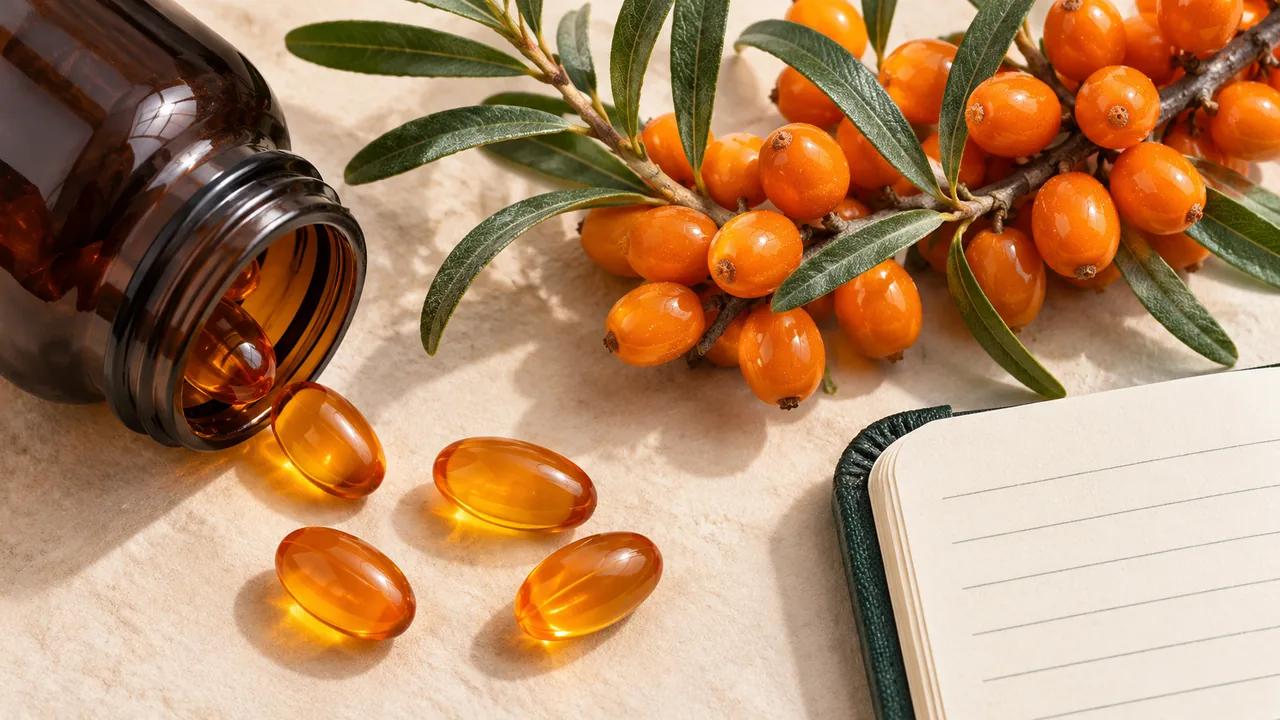
Possibly, but it is unproven and appears to be uncommon. We found no published trial or case report linking sea buckthorn or omega-7 capsules to acne, and in a 12-week trial of 500 mg omega-7 a day in 45 women, the only side effect reported was mild indigestion. Breakouts that start with a new capsule are more often a coincidence or another trigger, such as vitamin B12, whey protein, hormones or a new skin product. To find out, stop for 4 weeks, then restart at half the dose while taking weekly photos.
- There are no published reports of acne from sea buckthorn capsules, though that isn’t proof it never happens.
- In a 12-week trial of 500 mg/day omega-7 (palmitoleic acid), 2 of 45 women had mild indigestion and no skin side effects were reported.
- 5 g of sea buckthorn oil a day for 4 months barely changed the fatty acids in skin.
- Better-documented supplement triggers include vitamin B12 (rashes cleared 3–6 weeks after stopping) and possibly whey protein.
- Hormones, stress, new skin products and medicines can line up with a new capsule by chance.
- Use a 4-week stop, 4-week half dose, 4-week full dose plan with weekly photos. See a dermatologist for painful, deep or scarring acne.
Can sea buckthorn capsules cause acne?
A common complaint on Reddit: someone starts omega-7 softgels for dry eyes or skin, and weeks later has new pimples on the chin or jaw. Replies split between “it’s purging, push through” and “oil clogs pores, stop now.” Neither is backed by evidence. Here is what has been studied.
| What we know | Details | Evidence |
|---|---|---|
| Omega-7 capsules in a controlled trial | 90 women took 500 mg/day palmitoleic acid or corn oil for 12 weeks. Side effects: mild indigestion in 2 of 45 on omega-7 and 1 of 45 on placebo. No skin side effects were reported [1] | Trial |
| High-dose sea buckthorn oil for skin disease | 49 people with eczema took 5 g (10 capsules) of seed oil, pulp oil or placebo daily for 4 months. Eczema improved in the pulp oil and placebo groups [2] | Small trial |
| Effect on skin fats | In 16 of those patients, 5 g/day for 4 months barely changed the fatty acid makeup of the skin, which the authors called “well buffered” against diet changes [3] | Small study |
| Lab theory | Adding palmitic or palmitoleic acid to oil-gland cells in a dish made them fill with fat droplets [4] | Lab only |
| Case reports of acne from sea buckthorn capsules | None found in a PubMed search (October 2026) | None |
Nobody knows how often, if ever, oral sea buckthorn causes acne. The lab finding is a possible mechanism, but cells in a dish are bathed in fatty acids, while a capsule’s fat is digested and diluted through your body. One 500 mg softgel is about 0.5 g of fat, roughly a tenth of a teaspoon of cooking oil.
Oral fatty acids aren’t automatically bad for acne. In a 10-week randomized trial of 45 people with mild to moderate acne, 2,000 mg a day of fish-oil omega-3 or borage oil reduced acne lesions compared with no supplement [5]. It didn’t test sea buckthorn, but “oil in a capsule” and “oil on your face” are different questions. For oil applied to the skin, see our guide to sea buckthorn oil for acne.
Other suspects to rule out first
Adult acne has many triggers, and several tend to change when people start a new health routine. Check these before blaming the capsules.
| Suspect | Why it matters | How to check |
|---|---|---|
| Vitamin B12 (B-complex, energy drinks, injections, “hair, skin and nails” blends) | In 5 reported cases, facial papules and pustules appeared 1 week to 5 months after starting B12 and cleared 3–6 weeks after stopping [6]. In a UCLA study, 1 of 10 healthy people developed acne a week after a B12 dose [7] | Read every label you take for B12 (cobalamin) |
| Whey protein | In a study of 201 young men at gyms, 47% of those with acne used whey vs 27.7% without acne [8]. But a 6-month randomized trial of 30 g/day in 49 men with acne found no meaningful worsening [9] | Did you start a protein shake around the same time? |
| Hormones | Periods, pregnancy, perimenopause, menopause and starting or stopping the pill can all trigger breakouts [10] | Note where you are in your cycle and any change in birth control |
| Stress | Linked to flare-ups through extra androgens that stimulate oil glands [10] | Exams, a new job, poor sleep? |
| New skin or hair products | Moisturizers, sunscreens and hair products can cause acne; look for “non-comedogenic” or “oil-free” [10] | Anything new in the last 2 months, including a face oil |
| Medicines | Acne is a side effect of some medicines [10] | Ask your pharmacist. Don’t stop a prescription on your own |
| Diet changes | High-glycemic foods and cow’s milk may worsen acne in some studies, though others found no link [11] | Big shifts in sugar, white bread or milk intake |
Check the capsule label too. “Omega 3-6-7-9” and “beauty” formulas often add other oils, vitamins or herbs, so a co-ingredient may be the trigger. A single-ingredient softgel is the cleanest test. Our sea buckthorn capsule guide explains how to read the label.
Does the type of capsule matter?
“Sea buckthorn oil” can mean two very different oils, and many people don’t know which one they bought.
| Type | Main fatty acids | Omega-7 per 500 mg softgel |
|---|---|---|
| Pulp (fruit) oil, usually sold as “omega-7” | Palmitic 33%, oleic 26%, palmitoleic (omega-7) 25% [2] | About 125 mg |
| Seed oil | Linoleic 34%, alpha-linolenic (plant omega-3) 25%, oleic 19% [2] | Very little |
| Seed + pulp blend | Some of both | Varies by brand |
A worked example: if your label says 2 softgels (1,000 mg) of pulp oil a day, that is roughly 250 mg of palmitoleic acid, half the purified omega-7 dose in the 12-week trial, where no skin side effects were reported [1][2]. Batches vary, so treat that as a ballpark.
No study has compared breakouts on seed vs pulp oil. If you suspect a pulp-oil product, switching to seed oil is a reasonable experiment, since it has far less of the palmitic and palmitoleic acid used in the lab study [4]. That is a theory, not established advice. For more, see our omega-7 guide and sea buckthorn vs fish oil.
A 12-week stop-and-retest plan
The only way to know whether the capsules affect your skin is to test it, changing one thing at a time. The American Academy of Dermatology advises giving an acne treatment 6–8 weeks without adding or stopping other products [12]; the same patience applies here.
- Weeks 1–4, stop. Stop only the sea buckthorn capsules; keep skincare, other supplements and diet the same. Vitamin B12 breakouts cleared 3–6 weeks after stopping [6], so 4 weeks is a reasonable minimum.
- Photograph weekly. Same room, light and time of day; front and both sides of the face, plus chest and back if affected. Note new spots, cycle day and stress.
- Weeks 5–8, half dose. If your skin calmed down, restart at half your previous dose with a meal, such as 1 softgel instead of 2. See the best time to take sea buckthorn.
- Weeks 9–12, full dose. If weeks 5–8 stayed clear, go back to your usual amount.
- Decide. If breakouts clearly return when you restart, the capsules are a likely trigger (repeat the cycle once to be sure). If your skin didn’t improve when you stopped, they probably weren’t the cause.
Tip: photos beat memory. Acne comes and goes, and one bad week is easy to misremember. Our before-and-after guide has more on tracking skin changes.
Will the breakouts settle with time?
There is no data either way. No study shows a temporary “purge” from sea buckthorn or any omega-7 product. With the best-documented supplement trigger, vitamin B12, breakouts cleared after people stopped it [6].
If breakouts are mild, you can lower the dose and watch for 2–4 weeks. If they are spreading, inflamed or painful, stop. If you continue, our side effects and interactions guide lists who should check with a doctor first.
When to stop and see a dermatologist
Stop the capsules and get care if you notice:
- Large, deep or painful pimples (nodules or cysts), or acne that is leaving scars. The AAD advises seeing a dermatologist promptly for these [12].
- Acne that hasn’t cleared after a few months of treatment, or dark spots that remain after spots heal [12].
- A rash that doesn’t look like your usual acne: red bumps and pus spots without blackheads, sometimes spreading to the neck, chest, shoulders and upper back. Reported vitamin B12 eruptions looked like this [6], and a dermatologist can tell acne from look-alikes.
- Hives, swelling of the lips or face, or trouble breathing. That is a possible allergic reaction: stop the product and get emergency care.
- Pregnancy or trying to conceive. Talk to a dermatologist before using any acne treatment [12].
For a serious reaction, the FDA asks consumers to stop the product and report it through the Safety Reporting Portal [14]. Bring the label and your photo log to your appointment.
A 2026 review found that observational studies link acne to high-glycemic diets, skim milk, whey protein and an unbalanced omega-6 to omega-3 ratio, but controlled trials are few, and it advises against restrictive diets [13]. One supplement is rarely the whole story; keep using proven acne treatments while you test. For dosing, try our dosage calculator.
Frequently asked questions
Can sea buckthorn capsules cause acne?
Possibly, but it is unproven. We found no published trial or case report linking them to acne, and a 12-week trial of 500 mg omega-7 a day reported only mild indigestion.
Does omega-7 cause breakouts?
There is no good evidence that it does. In a randomized trial of 90 women, 500 mg of palmitoleic acid (omega-7) a day for 12 weeks improved skin hydration, and no skin side effects were reported.
Is breaking out from sea buckthorn a sign of purging?
No study shows a purging effect from sea buckthorn or any omega-7 supplement. If breakouts start after a new capsule, stop it for 4 weeks and see whether your skin settles.
How long after stopping a supplement does acne clear?
It depends on the cause. In reported cases of acne-like eruptions from vitamin B12, the spots cleared 3 to 6 weeks after stopping. Give it at least 4 weeks before judging.
Is seed oil or pulp oil less likely to cause acne?
No study has compared them. Pulp oil is higher in palmitic and palmitoleic acid and seed oil in linoleic and alpha-linolenic acid, so switching to seed oil is a reasonable experiment.
Can I take sea buckthorn capsules with acne medicine?
We found no studies on combining them. Keep using your acne treatment, and ask your dermatologist before adding supplements, especially if you take isotretinoin or another prescription.
When should I see a dermatologist about breakouts?
See one for deep, painful or scarring acne, acne that has not cleared after a few months, dark spots that remain after spots heal, or any rash with swelling or hives.
- Koh YG, Seok J, Park JW, et al. Efficacy and safety of oral palmitoleic acid supplementation for skin barrier improvement: a 12-week, randomized, double-blinded, placebo-controlled study. Heliyon. 2023;9(6):e16711. PubMed
- Yang B, Kalimo KO, Mattila LM, et al. Effects of dietary supplementation with sea buckthorn (Hippophaë rhamnoides) seed and pulp oils on atopic dermatitis. J Nutr Biochem. 1999;10(11):622-30. PubMed
- Yang B, Kalimo KO, Tahvonen RL, et al. Effect of dietary supplementation with sea buckthorn (Hippophaë rhamnoides) seed and pulp oils on the fatty acid composition of skin glycerophospholipids of patients with atopic dermatitis. J Nutr Biochem. 2000;11(6):338-40. PubMed
- Hossini AM, Hou X, Exner T, et al. Free fatty acids induce lipid accumulation, autophagy, and apoptosis in human sebocytes. Skin Pharmacol Physiol. 2023;36(1):1-15. PubMed
- Jung JY, Kwon HH, Hong JS, et al. Effect of dietary supplementation with omega-3 fatty acid and gamma-linolenic acid on acne vulgaris: a randomised, double-blind, controlled trial. Acta Derm Venereol. 2014;94(5):521-5. PubMed
- Veraldi S, Benardon S, Diani M, Barbareschi M. Acneiform eruptions caused by vitamin B12: a report of five cases and review of the literature. J Cosmet Dermatol. 2018;17(1):112-5. PubMed
- Kang D, Shi B, Erfe MC, Craft N, Li H. Vitamin B12 modulates the transcriptome of the skin microbiota in acne pathogenesis. Sci Transl Med. 2015;7(293):293ra103. PubMed
- Muhaidat J, Qablan A, Gharaibeh F, et al. The effect of whey protein supplements on acne vulgaris among male adolescents and young adults: a case-control study from north of Jordan. Dermatol Res Pract. 2024;2024:2158229. PubMed
- Sompochpruetikul K, Khongcharoensombat T, Chongpison Y, et al. Whey protein and male acne: a double-blind, randomized controlled trial. J Dermatol. 2024;51(7):1022-5. PubMed
- American Academy of Dermatology. Adult acne. aad.org
- American Academy of Dermatology. Can the right diet get rid of acne? aad.org
- American Academy of Dermatology. Adult acne: how to treat it. aad.org
- Dessinioti C, Dreno B. Diet and acne: facts and controversies. J Eur Acad Dermatol Venereol. 2026;40(11):1765-74. PubMed
- US Food and Drug Administration. How to report a problem with dietary supplements. fda.gov
This article is for general information only and is not medical advice. Talk to your doctor or pharmacist before starting any supplement, especially if you take medication, are pregnant or breastfeeding, or have a health condition.