
Sea Buckthorn Oil for Dry Eyes: What the Trials Show
What the capsule and eyelid-spray studies found, how long it takes, what contact lens wearers should know, and why you should never put the oil itself in your eyes.
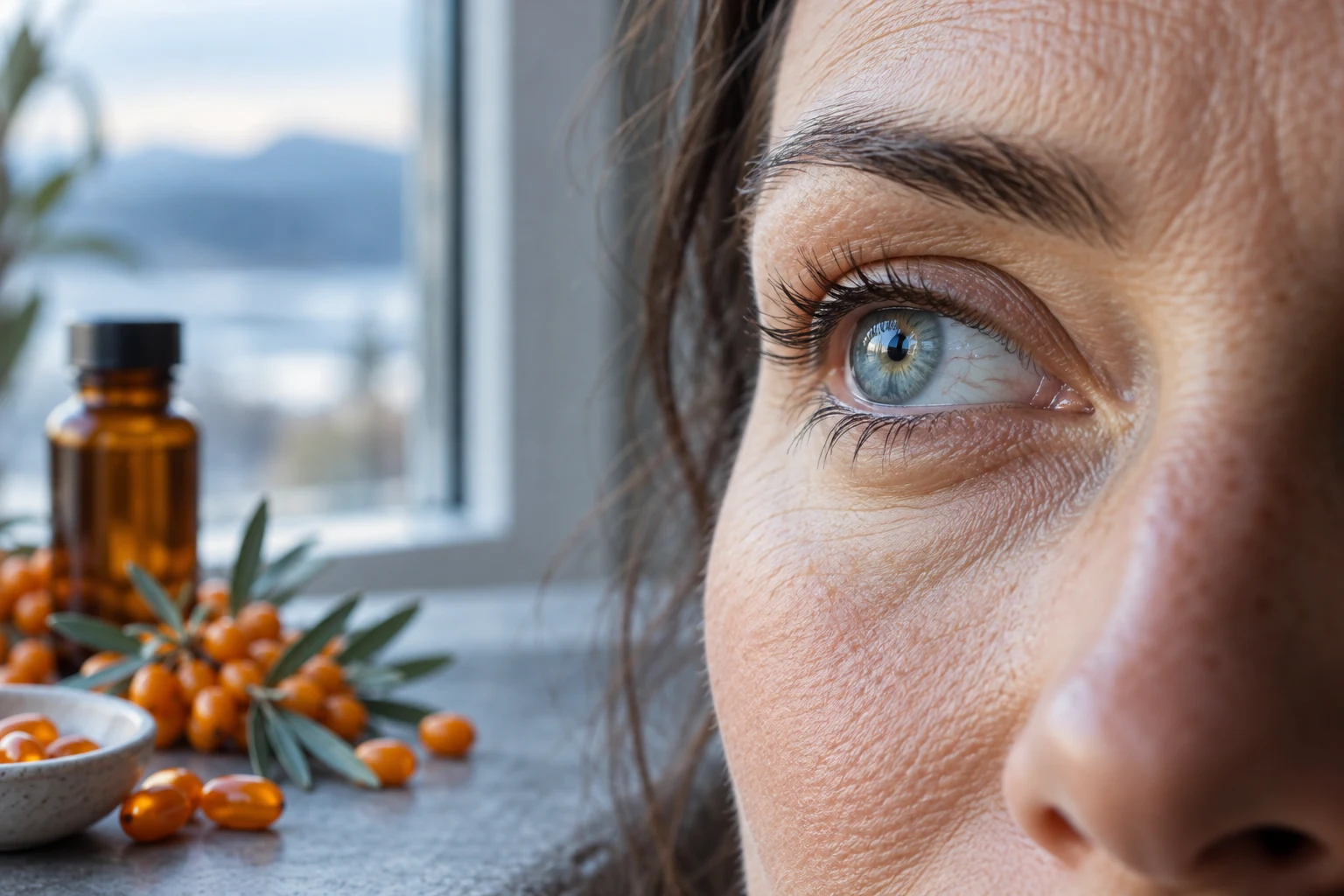
Yes, sea buckthorn oil may help dry eyes, though the evidence is limited. In a randomized trial of 100 adults, 2 g of oil a day by mouth for 3 months (four 500 mg softgels) limited the cold-season rise in tear-film osmolarity and eased redness and burning compared with placebo. A separate study found an eyelid spray containing sea buckthorn oil relieved symptoms within 9 days to 6 weeks. Expect a modest effect, give capsules about 3 months, and never put plain sea buckthorn oil into your eyes.
- Capsules: 2 g/day for 3 months beat placebo on a key dry-eye marker and on redness or burning in a 100-person trial.
- Eyelid spray: a spray with sea buckthorn oil and hyaluronate, used on closed eyelids, lowered dry-eye symptom scores in studies of 10 and 40 people.
- Omega-7 and dry eyes: sea buckthorn pulp oil and its omega-7 restored tear production in mice. That hasn’t been tested in people.
- A large fish oil trial (535 people, 3,000 mg EPA + DHA a day) found no benefit over placebo, so omega-3 capsules aren’t a sure thing either.
- Never put face oil or capsule contents in your eyes. Anything used in the eye must be sterile.
- See an eye doctor for eye pain, vision changes, discharge, or dryness that doesn’t improve with artificial tears.
Sea buckthorn oil for dry eyes: the evidence
Dry eye happens when your eyes don’t make enough tears or your tears don’t work properly. It causes scratchiness, stinging or burning, redness, light sensitivity and blurry vision. The National Eye Institute says you’re more likely to have it if you’re 50 or older, female or wear contact lenses [1].
Sea buckthorn has been studied for dry eye in two ways: as an oil you swallow and as a spray you put on closed eyelids. Here’s how those studies compare with fish oil, the supplement most often suggested for dry eyes.
| Approach | Study | Result | Evidence |
|---|---|---|---|
| Oral sea buckthorn oil | 100 adults aged 20–75, 2 g/day for 3 months, fall to winter [2] | Smaller rise in tear osmolarity; less redness and burning vs placebo | Moderate |
| Sea buckthorn eyelid spray | 10 people for 9 days, then 40 people for 6 weeks [3] | Lower symptom scores than a reference spray or an untreated eye | Early |
| Omega-7 (palmitoleic acid) | Mouse dry-eye model [6] | Pulp oil and omega-7 restored tear secretion; seed oil did not | Animal only |
| Fish oil (for comparison) | 535 adults, 3,000 mg EPA + DHA/day for 12 months [5] | No better than olive oil placebo | No effect |
Sea buckthorn capsules for dry eyes
The main trial came from Finland. Researchers gave 100 women and men aged 20 to 75 with dry-eye symptoms either 2 g of sea buckthorn oil or a placebo oil every day for 3 months, running from fall into winter, when cold air and indoor heating tend to make dry eye worse. Eighty-six people finished [2].
- Tear osmolarity (how salty and concentrated tears are, a key sign of dry eye) rose in both groups over the winter, but significantly less in the sea buckthorn group.
- Redness and burning tended to be milder with sea buckthorn. Redness reached statistical significance in one analysis and burning in the other.
A follow-up analysis of the same trial found that the oil did not change the fatty acids in the tear film, so the benefit seems to work some other way. The authors suggested the oil’s carotenoids, vitamin E or anti-inflammatory effects on the eyelid oil glands as possibilities [4].
That’s one trial of modest size, so think of it as promising rather than proven. Still, it’s a better result than fish oil managed: in the much larger DREAM trial, people taking 3,000 mg of EPA plus DHA daily for a year improved by 13.9 points on a symptom scale, while the olive-oil placebo group improved by 12.5, a difference that wasn’t significant [5]. The NIH notes the same mixed picture for omega-3s and dry eye [7]. If you’re choosing between the two, our sea buckthorn vs fish oil comparison goes deeper.
Eye sprays and drops
A second Finnish team tested a spray emulsion of sea buckthorn oil and sodium hyaluronate sprayed onto closed eyelids, not into the open eye [3]. Adults aged 25 to 70 with moderate or severe dryness, burning or grittiness took part in three stages:
- Safety check (2 people): 4 sprays in one day were well tolerated.
- 9 days (10 people): one eye got the sea buckthorn spray and the other a commercial reference spray. Symptom scores (OSDI) fell more in the sea buckthorn eye.
- 6 weeks (40 people): one eye got the spray and the other none. The treated eye had lower symptom scores, less dryness and less watering in daily logs.
These were small studies, and comparing one eye with the other in the same person can’t fully separate the two eyes’ symptoms. The spray also contained hyaluronate, a common moisturizing ingredient in artificial tears, so not all of the effect may come from sea buckthorn.
A sea buckthorn seed oil eye drop (a nano-emulsion) has been tested only in rabbits so far, in a 2026 lab study [8]. There’s no human data, and we know of no such drop approved by the FDA.
Omega-7 and dry eyes
Sea buckthorn pulp oil is one of the richest plant sources of omega-7 (palmitoleic acid). In a mouse model of dry eye, pulp oil, but not seed oil, restored tear secretion to normal, and purified palmitoleic acid worked about as well as the pulp oil while calming inflammation in the tear gland [6]. Two of the authors were employees of a company involved in the research.
It’s an interesting lead, but no human trial has tested omega-7 alone for dry eyes. For more on this fatty acid, see omega-7 benefits, sources and side effects.
Contact lens wearers
Contact lenses are a known risk factor for dry eye [1]. Here’s how sea buckthorn fits:
- Capsules never touch your lenses, so wearing contacts is not a reason to avoid them. The published abstract doesn’t say how many trial participants wore lenses.
- Eyelid sprays go on closed lids. Ask your eye doctor before using one, and follow the product’s own lens instructions.
- Eye drops with lenses in: the American Academy of Ophthalmology says preservative-free artificial tears and drops labeled for contact lens wearers are safe with lenses in, and that preservative-free drops may be better if you use drops more than 4 times a day [9].
What not to put in your eyes
Never put sea buckthorn face oil, capsule contents or homemade mixtures into your eyes. The FDA says any drug used in the eye must be sterile to reduce the risk of infection, and recalls of contaminated eye drops have been linked to infections, partial vision loss and blindness [10]. Face oils and supplement capsules are not made as sterile eye products, and the oil would blur your vision.
The FDA also advises avoiding eye products labeled homeopathic and products with ingredients not meant for eyes, such as honey or MSM, and stopping any eye product that causes discharge, pain, vision changes or discomfort [10]. When you apply sea buckthorn oil to your face, keep it away from the lash line; see our tips on using sea buckthorn oil on your face overnight.
Standard dry-eye care comes first. The NEI lists artificial tears for mild dry eye, prescription drops such as cyclosporine or lifitegrast, tear duct plugs, and habits like humidifiers, screen breaks and wraparound sunglasses [1]. Severe untreated dry eye can damage the cornea, so see an eye doctor if symptoms persist.
How long it takes and how to take it
For an overview of oral oil amounts and capsule strengths, explore our sea buckthorn dosage calculator.
- Eyelid spray: symptom differences showed up within 9 days in the smaller study, and held at 6 weeks [3].
- Capsules: the trial measured results after 3 months [2]. Give it at least 8–12 weeks before judging.
Example routine (trial dose)
Most sea buckthorn softgels hold 500 mg, so 4 softgels = 2 g, the dose used in the Finnish trial. Take 2 with breakfast and 2 with dinner. Because the trial ran through fall and winter, starting in September or October lets you test it during the months when dry eye usually flares. Keep a simple 0–10 log of dryness and burning each week so you can tell whether it’s working. Our capsule guide explains seed, pulp and blended oils, and the before-and-after timeline shows what to expect when.
Check with your doctor first if you take blood thinners or antiplatelet drugs (sea buckthorn oil at 5 g a day slowed platelet clumping in a small trial [11]), are pregnant or breastfeeding, or have surgery coming up; stop 2 weeks before. Dry eye can also come from Sjögren syndrome, lupus or medicines, which a doctor should rule out [1]. More in our guide to sea buckthorn for menopause and dry eyes and side effects and interactions.
Frequently asked questions
Does sea buckthorn oil help dry eyes?
It may. In a 100-person randomized trial, 2 g a day by mouth for 3 months limited a key dry-eye marker and eased redness and burning compared with placebo. The evidence is limited to a few small studies.
How much sea buckthorn oil should I take for dry eyes?
The trial used 2 g a day, which is four 500 mg softgels, taken for 3 months. Check with your doctor first if you take blood thinners or are pregnant.
How long do sea buckthorn capsules take to work for dry eyes?
The capsule trial measured results after 3 months, so give it at least 8 to 12 weeks. An eyelid spray study saw symptom changes within 9 days.
Can I put sea buckthorn oil directly in my eyes?
No. Anything used in the eye must be sterile, and cosmetic oils are not. The studied spray was applied to closed eyelids, not into the eye.
Does omega-7 help dry eyes?
Omega-7 from sea buckthorn pulp oil restored tear production in mice, but it has not been tested alone for dry eyes in people.
Is sea buckthorn better than fish oil for dry eyes?
The evidence currently leans that way, but it is thin. A 100-person trial of sea buckthorn oil was positive, while a 535-person trial found fish oil no better than placebo.
Can I take sea buckthorn capsules if I wear contact lenses?
Yes, capsules do not touch your lenses. For drops with lenses in, use preservative-free artificial tears or drops labeled for contact lenses, and ask your eye doctor.
Is sea buckthorn good for overall eye health?
Beyond dry eye, the eye research is mostly in animals or cells. There is no human evidence that it prevents macular degeneration or cataracts.
- National Eye Institute. Dry eye. Last updated August 6, 2025. nei.nih.gov
- Larmo PS, Järvinen RL, Setälä NL, et al. Oral sea buckthorn oil attenuates tear film osmolarity and symptoms in individuals with dry eye. J Nutr. 2010;140(8):1462-8. PubMed
- Larmo P, Järvinen R, Laihia J, et al. Effects of a sea buckthorn oil spray emulsion on dry eye. Cont Lens Anterior Eye. 2019;42(4):428-33. PubMed
- Järvinen RL, Larmo PS, Setälä NL, et al. Effects of oral sea buckthorn oil on tear film fatty acids in individuals with dry eye. Cornea. 2011;30(9):1013-9. PubMed
- Dry Eye Assessment and Management Study Research Group; Asbell PA, Maguire MG, et al. n-3 fatty acid supplementation for the treatment of dry eye disease. N Engl J Med. 2018;378(18):1681-90. PubMed
- Kimura Y, Mori D, Imada T, et al. Restoration of tear secretion in a murine dry eye model by oral administration of palmitoleic acid. Nutrients. 2017;9(4):364. PubMed
- NIH Office of Dietary Supplements. Omega-3 fatty acids: fact sheet for consumers. ods.od.nih.gov
- Cheng M, Bi X, Zhao S, et al. A sea buckthorn seed oil nano-emulsion in the management of digital screen-induced ocular conditions. Eur J Pharm Biopharm. 2026;225:115118. PubMed
- American Academy of Ophthalmology. Should I take out my contacts to apply artificial tears? Ask an Ophthalmologist, February 4, 2022. aao.org
- US Food and Drug Administration. What you should know about eye drops. fda.gov
- Johansson AK, Korte H, Yang B, Stanley JC, Kallio HP. Sea buckthorn berry oil inhibits platelet aggregation. J Nutr Biochem. 2000;11(10):491-5. PubMed
This article is for general information only and is not medical advice. Talk to your doctor or pharmacist before starting any supplement, especially if you take medication, are pregnant or breastfeeding, or have a health condition.