Can You Get Too Much Vitamin A From Sea Buckthorn? Carotenoids & Yellow Skin
The difference between beta-carotene and preformed vitamin A, how much is really in a dose of sea buckthorn oil, why skin can turn yellow-orange, and when yellow skin needs a doctor.
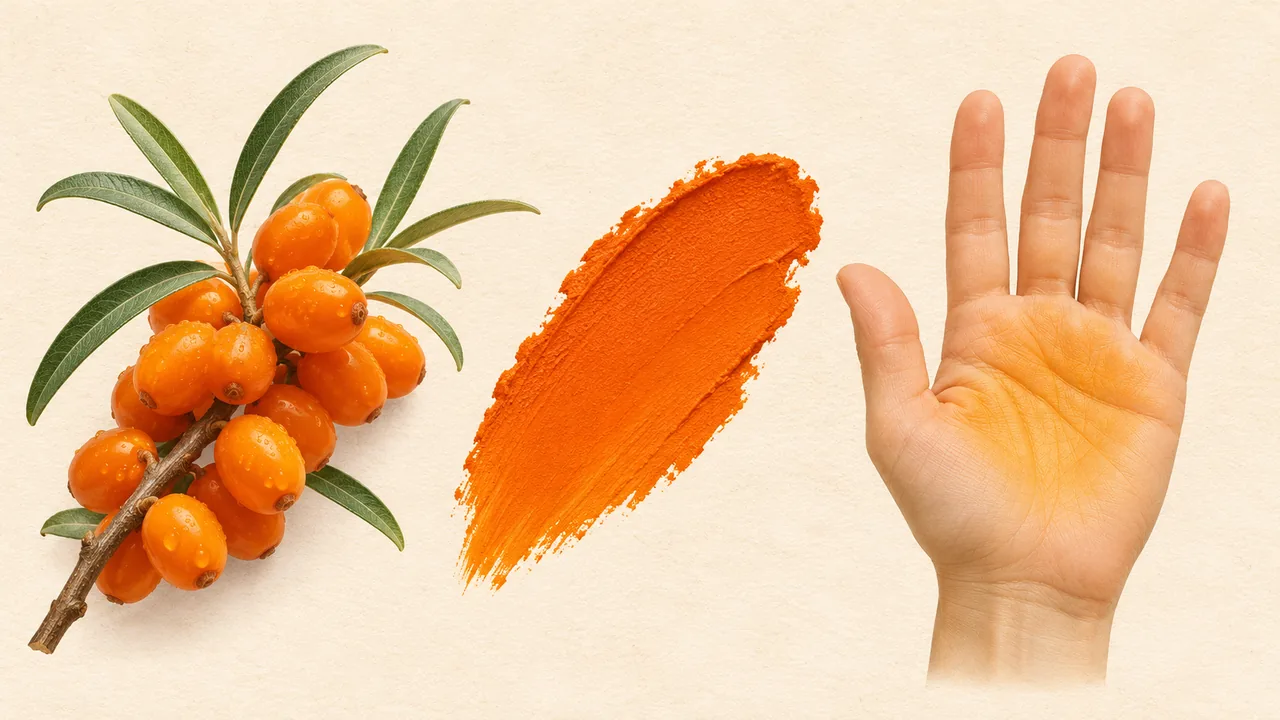
Not in the way people worry about. Sea buckthorn has no preformed vitamin A (retinol), only carotenoids, and just some of them (mainly beta-carotene) become vitamin A. The 3,000 mcg upper limit applies to preformed vitamin A. A 2 g daily dose of one lab-analyzed fruit oil gives about 0.3 mg of beta-carotene, roughly 30–170 mcg RAE. Very high intakes over months can turn palms and soles yellow-orange (carotenemia), which is harmless and fades. Yellow eyes are not carotenemia: see a doctor.
- Sea buckthorn has provitamin A, not retinol. The adult upper limit of 3,000 mcg RAE applies only to preformed vitamin A.
- Most of its pigment isn’t vitamin A. About 76% of the carotenoids in one analyzed oil were zeaxanthin, which isn’t converted.
- 2 g of oil ≈ 0.3 mg beta-carotene. One cup of canned carrot juice has about 22 mg.
- Carotenemia turns palms and soles yellow-orange, leaves the eyes white, and fades over weeks to months.
- Smokers: skip beta-carotene supplements; 20–30 mg a day raised lung cancer risk in two large trials.
- Pregnancy: the concern is preformed vitamin A from supplements, cod liver oil and liver, not beta-carotene.
Beta-carotene vs preformed vitamin A: why the difference matters
“Vitamin A” can mean two different things, according to the NIH Office of Dietary Supplements (ODS) [1]:
- Preformed vitamin A (retinol and esters such as retinyl palmitate) comes from animal foods and many supplements. The body stores the excess, mainly in the liver.
- Provitamin A carotenoids (beta-carotene, alpha-carotene, beta-cryptoxanthin) are plant pigments the body converts into vitamin A. Lutein, zeaxanthin and lycopene are not converted.
Sea buckthorn is a plant, so it only offers the second group. The adult upper limit (UL) of 3,000 mcg RAE a day applies only to animal foods and to supplements whose vitamin A is retinol or its esters [1]. Beta-carotene is not known to cause birth defects, and the most common effect of long-term excess is carotenodermia, a harmless yellow-orange skin color that reverses when you cut back [1].
| Preformed vitamin A | Beta-carotene | |
|---|---|---|
| Main sources | Liver, fish liver oils, dairy, eggs, many multivitamins | Orange and green plants, including sea buckthorn |
| Counts toward the UL? | Yes | No |
| Absorption | 70–90% from supplements | 10–30% from foods |
| Risk from excess | Liver damage, birth defects | Harmless yellow skin; lung cancer risk with high-dose pills in smokers |
The RDA is 900 mcg RAE for men and 700 for women. RAE puts both forms on one scale: 1 mcg RAE equals 1 mcg retinol, 2 mcg supplemental beta-carotene, 12 mcg food beta-carotene, or 24 mcg alpha-carotene or beta-cryptoxanthin [1].
How much vitamin A is in sea buckthorn?
The oil. A Romanian lab found 303 mg of carotenoids per 100 g in a cold-pressed fruit oil. Zeaxanthin and its esters made up about 76%; beta-carotene was about 16.7 mg per 100 g and alpha-carotene 5.8 mg [2]. Oils differ: in a rat feeding study, another pulp oil’s carotenoids were mainly beta-carotene, and it raised retinol in the rats’ livers [3].
The berries. Four Swedish-grown cultivars held 1.5 to 18.5 mg of total carotenoids per 100 g (3.5 oz) of fresh berries [4].
Worked example: a typical capsule dose
The Finnish dry-eye trial used 2 g of oil a day, four 500 mg softgels [5]. With the analyzed oil above:
- 2 g × 16.7 mg per 100 g = about 0.33 mg (335 mcg) beta-carotene
- As food beta-carotene (12:1): about 28 mcg RAE; as supplement beta-carotene (2:1): about 170 mcg RAE
- Alpha-carotene and beta-cryptoxanthin add a little; total carotenoids are about 6 mg.
Even the generous figure is under a quarter of a woman’s RDA, and none of it counts toward the UL. See our capsules guide and sea buckthorn oil for dry eyes.
Label check: if a sea buckthorn product lists vitamin A, look at its form. Beta-carotene doesn’t count toward the UL; added retinyl palmitate or retinyl acetate does [1].
Sea buckthorn and yellow skin: carotenemia from supplements and food
Carotenemia (or carotenodermia) is a yellow-orange skin color from high blood carotenoids. It shows most on the palms and soles, sometimes the nose and forehead, while the whites of the eyes stay white [11][12]. It is benign [12].
How much does it take? It develops with carotenoid-rich foods or beta-carotene supplements above about 30 mg a day over months [7]. In a German study, 12 women took 24 mg of beta-carotene daily for 12 weeks; palm carotenoids rose 2.2-fold and forehead 2.4-fold, then fell after they stopped [8].
The sea buckthorn case. A 45-year-old Romanian man developed yellow skin over 3 months. After a full workup, doctors traced it to 6 months of heavy sea buckthorn intake that he hadn’t thought worth mentioning [9]. A Japanese case involved a 66-year-old woman on carotene supplements [10]. Tell your doctor about every supplement.
Some people turn yellow on normal amounts: hypothyroidism, diabetes, anorexia nervosa and genetics can all play a part [7]. Mention it at your next checkup.
How long does it take to fade?
Typically several weeks or months after beta-carotene levels drop [11]. No treatment is needed: cut back on sea buckthorn and extras like carrot juice or beta-carotene pills, and keep eating vegetables normally. Orange only where you apply the oil, and it washes off? That’s a surface stain, not carotenemia.
When yellow skin is NOT carotenemia
Jaundice comes from a buildup of bilirubin, not carotenoids, and needs a medical checkup [11][13]. Check the whites of your eyes in daylight: MedlinePlus notes that if your skin is yellow but they aren’t, you may not have jaundice [13].
| Sign | Carotenemia | Jaundice |
|---|---|---|
| Whites of the eyes | Stay white | Yellow |
| Where it shows | Palms, soles, nose, forehead | All over, plus eyes and inside the mouth |
| Urine | Normal | Often dark or brown |
| Stools | Normal | Often pale or clay-colored |
| Itching | Not typical | Common |
| What to do | Cut back on carotenoids | Contact a doctor promptly |
See a doctor if the whites of your eyes are yellow, or if yellow skin comes with dark urine, pale stools, itching or feeling unwell. Don’t assume it’s the supplement. See also sea buckthorn and the liver.
Stacking: multivitamins, cod liver oil and carrot juice
The real vitamin A risk in a supplement routine is usually the preformed vitamin A in other products.
| Source | Type | Counts toward the 3,000 mcg UL? |
|---|---|---|
| Multivitamins | Often 750–1,050 mcg RAE, as retinyl acetate or palmitate, beta-carotene, or both [1] | Only the retinol part |
| Stand-alone vitamin A pills | 3,000 mcg RAE is common [1] | Yes, if retinol-based |
| Cod liver oil, fish liver oils | Preformed vitamin A; amount varies by brand | Yes |
| Beef liver | 6,582 mcg RAE per 3 oz [1] | Yes |
| Carrot juice | About 22 mg beta-carotene per cup [6] | No, but a big carotenemia driver |
| Sea buckthorn oil, juice, berries | Mostly zeaxanthin plus some beta-carotene [2] | No |
Example: a supplement listing 3,000 mcg RAE with 60% from beta-carotene provides 1,200 mcg of preformed vitamin A [1]; cod liver oil or liver adds more on top. A daily cup of carrot juice gives about 65 times the beta-carotene in 2 g of the analyzed oil.
On a retinoid such as isotretinoin or acitretin? Don’t add vitamin A supplements without your doctor’s OK [1]. Children have lower ULs (600 mcg at ages 1–3, 900 mcg at 4–8) [1]; see is sea buckthorn safe for children.
Smokers and high-dose beta-carotene
- ATBC (Finland): 29,133 male smokers aged 50–69 took 20 mg of beta-carotene a day, vitamin E, both or placebo for 5–8 years. Beta-carotene raised lung cancer incidence by 18% and total deaths by 8% [14].
- CARET (US): 18,314 smokers, former smokers and asbestos workers took 30 mg of beta-carotene plus 25,000 IU of retinyl palmitate daily. Lung cancer rose 28% and deaths from any cause 17%; the trial stopped early [15].
The ODS concludes that large supplemental doses appear harmful for current and former smokers; in the AREDS2 eye study (15 mg beta-carotene), 31 of 34 people with lung cancer were former smokers [1].
For sea buckthorn: those trials used isolated beta-carotene at 60–90 times the amount in 2 g of the analyzed oil. No study has tested sea buckthorn in smokers, so it isn’t proven safe for them. If you smoke or used to, avoid beta-carotene supplements, keep sea buckthorn to studied amounts (see our dosage calculator), and don’t stack carotenoid products.
Pregnancy and vitamin A
Preformed vitamin A above the UL, and retinoid medicines, can cause birth defects of the eyes, skull, lungs and heart. Experts advise anyone who is or might be pregnant, or is breastfeeding, not to take more than 3,000 mcg RAE a day from supplements. Beta-carotene is not known to cause birth defects. The pregnancy RDA is 770 mcg RAE (ages 19–50) [1].
- Check your prenatal vitamin for the form of vitamin A and how much is retinol.
- Ask before adding cod liver oil or liver-based supplements.
- Sea buckthorn’s carotenoids aren’t the vitamin A concern, but sea buckthorn supplements haven’t been studied in pregnancy. Read what the NIH says about sea buckthorn in pregnancy and talk to your provider.
Other cautions are in sea buckthorn side effects and interactions.
Frequently asked questions
Does sea buckthorn contain vitamin A?
Sea buckthorn vitamin A comes only from provitamin A carotenoids, mainly beta-carotene, which the body turns into vitamin A. It has no preformed vitamin A (retinol). Most of its orange pigment is zeaxanthin, which is not converted.
Can you overdose on vitamin A from sea buckthorn oil?
Not in the toxic sense. The 3,000 mcg RAE upper limit applies to preformed vitamin A, not beta-carotene. Very high intake over months can turn skin yellow-orange, which is harmless and reversible.
How much beta-carotene is in sea buckthorn oil?
Sea buckthorn beta-carotene levels vary, but one lab-analyzed fruit oil had about 16.7 mg per 100 g, or roughly 0.3 mg in a 2 g daily dose. Oils vary with the berries and processing.
Can sea buckthorn turn your skin yellow?
Yes, at high intakes over months. One man turned yellow after about 6 months of heavy sea buckthorn use. In carotenemia the palms and soles turn yellow-orange but the whites of the eyes stay white.
How long does carotenemia take to go away?
Usually several weeks to a few months after you cut back on carotenoid-rich foods and supplements. No treatment is needed.
Can I take sea buckthorn with a multivitamin or cod liver oil?
Sea buckthorn adds no preformed vitamin A. Check how much retinol your multivitamin and cod liver oil provide, since those count toward the 3,000 mcg limit.
Should smokers avoid sea buckthorn?
Smokers should avoid beta-carotene supplements, which raised lung cancer risk at 20 to 30 mg a day. Sea buckthorn oil supplies far less but has not been studied in smokers, so stick to studied amounts.
- NIH Office of Dietary Supplements. Vitamin A and carotenoids: fact sheet for health professionals. Updated March 10, 2025. ODS
- Tudor C, Bohn T, Iddir M, et al. Sea buckthorn oil as a valuable source of bioaccessible xanthophylls. Nutrients. 2019;12(1):76. PubMed
- Czaplicki S, Ogrodowska D, Zadernowski R, Konopka I. Effect of sea-buckthorn (Hippophaë rhamnoides L.) pulp oil consumption on fatty acids and vitamin A and E accumulation in adipose tissue and liver of rats. Plant Foods Hum Nutr. 2017;72(2):198-204. PubMed
- Andersson SC, Olsson ME, Johansson E, Rumpunen K. Carotenoids in sea buckthorn (Hippophae rhamnoides L.) berries during ripening and use of pheophytin a as a maturity marker. J Agric Food Chem. 2009;57(1):250-8. PubMed
- Larmo PS, Järvinen RL, Setälä NL, et al. Oral sea buckthorn oil attenuates tear film osmolarity and symptoms in individuals with dry eye. J Nutr. 2010;140(8):1462-8. PubMed
- U.S. Department of Agriculture, Agricultural Research Service. FoodData Central: Carrot juice, canned (SR Legacy, FDC ID 170491). USDA
- Priyadarshani AMB. Insights of hypercarotenaemia: a brief review. Clin Nutr ESPEN. 2018;23:19-24. PubMed
- Stahl W, Heinrich U, Jungmann H, et al. Increased dermal carotenoid levels assessed by noninvasive reflection spectrophotometry correlate with serum levels in women ingesting Betatene. J Nutr. 1998;128(5):903-7. PubMed
- Grad SC, Muresan I, Dumitrascu DL. Generalized yellow skin caused by high intake of sea buckthorn. Forsch Komplementmed. 2012;19(3):153-6. PubMed
- Takita Y, Ichimiya M, Hamamoto Y, Muto M. A case of carotenemia associated with ingestion of nutrient supplements. J Dermatol. 2006;33(2):132-4. PubMed
- Cleveland Clinic. Carotenemia: what to know about orange hands and feet. Health Essentials, 2026. Cleveland Clinic
- Edigin E, Asemota IR, Olisa E, Nwaichi C. Carotenemia: a case report. Cureus. 2019;11(7):e5218. PubMed
- MedlinePlus Medical Encyclopedia. Jaundice. U.S. National Library of Medicine. MedlinePlus
- Alpha-Tocopherol, Beta Carotene Cancer Prevention Study Group. The effect of vitamin E and beta carotene on the incidence of lung cancer and other cancers in male smokers. N Engl J Med. 1994;330(15):1029-35. PubMed
- Omenn GS, Goodman GE, Thornquist MD, et al. Effects of a combination of beta carotene and vitamin A on lung cancer and cardiovascular disease. N Engl J Med. 1996;334(18):1150-5. PubMed
This article is for general information only and is not medical advice. Talk to your doctor or pharmacist before starting any supplement, especially if you take medication, are pregnant or breastfeeding, or have a health condition.