
Is Sea Buckthorn Oil Safe for Fungal Acne and Seborrheic Dermatitis?
Where the “Malassezia feeds on C11–C24 fatty acids” rule really comes from, why both seed and pulp oil fall inside it, what that does and doesn’t prove, and a careful plan if you still want to try it.
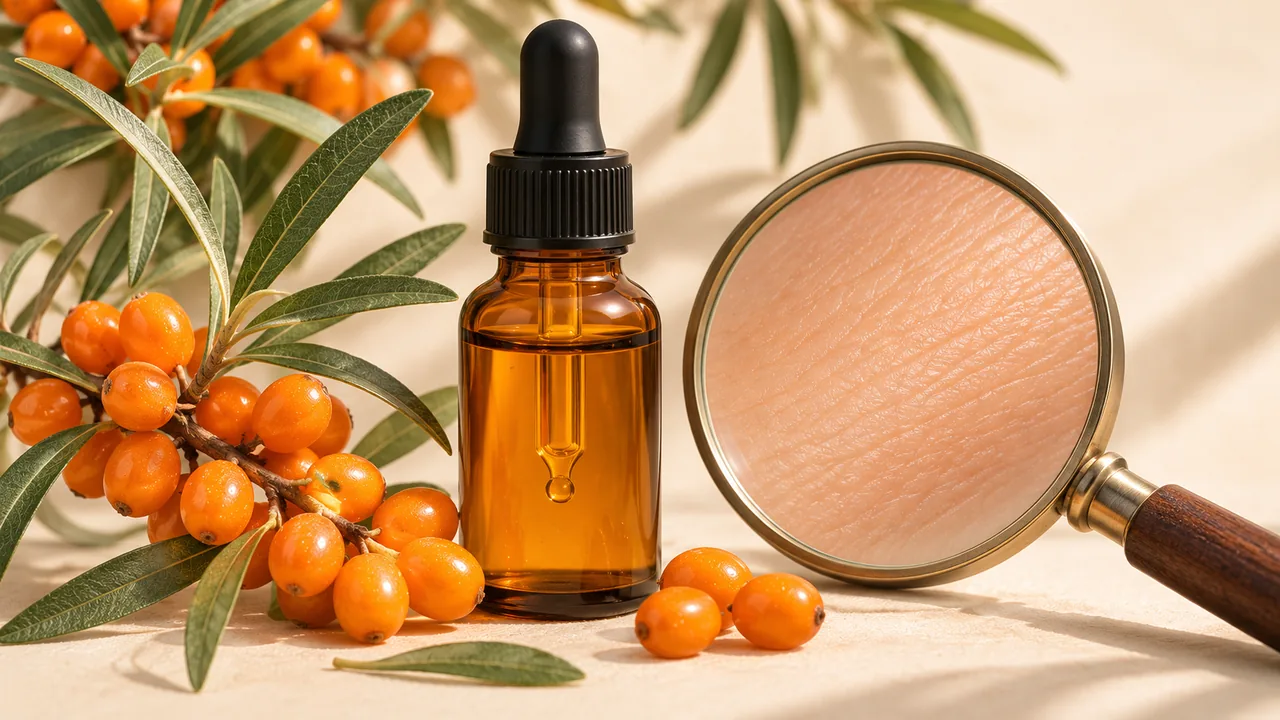
Sea buckthorn oil is not “fungal acne safe” by the usual rule. Both seed and pulp oil are made almost entirely of 16- and 18-carbon fatty acids, the chain lengths Malassezia yeast used for growth in lab studies, and pulp oil is about one-third palmitic acid, a fat that supported Malassezia growth on its own in a 2025 lab study. That rule comes from lab dishes, not skin trials, and no study has tested sea buckthorn oil on fungal acne or seborrheic dermatitis. If you have active fungal acne, treat it first with an antifungal such as ketoconazole, selenium sulfide or pyrithione zinc, and only then patch test any oil on one small area for 4 weeks.
- Fungal acne is Malassezia folliculitis: itchy, same-size 1–2 mm bumps on the forehead, chest and back, with no blackheads or cysts.
- The chain-length rule is real lab science but thin: 1960s cultures grew only when fatty acids longer than 10 carbons were supplied. We could not trace the C24 upper limit to a primary study.
- Seed and pulp oil both fall inside the range. Pulp oil is heavy in palmitic acid; seed oil in linoleic, ALA and oleic acid.
- No clinical study has tested sea buckthorn oil on Malassezia, fungal acne or seborrheic dermatitis.
- Treat first: topical or oral antifungals clear most cases, but relapses are common.
- Lower-risk moisturizers in theory: squalane (a hydrocarbon, not a fatty acid) and caprylic/capric (MCT) oils, which inhibited Malassezia in a lab study.
What fungal acne actually is
“Fungal acne” is the internet name for Malassezia folliculitis (formerly pityrosporum folliculitis): an overgrowth of Malassezia, a yeast that lives on everyone’s skin, inside hair follicles. It isn’t true acne, and acne treatments often fail. In one study of 110 people with lab-confirmed Malassezia folliculitis, 75% had already been treated for acne without success [1].
| Acne | Fungal acne (Malassezia folliculitis) | |
|---|---|---|
| Bumps | Mixed sizes; blackheads, whiteheads, sometimes cysts | Uniform 1–2 mm red or skin-colored bumps and pustules; no blackheads, nodules or cysts [1] |
| Itch | Uncommon | Common; about 72% of patients in a pooled review [2] |
| Where | Face, chest, back | Face (57%), back (53%), arms (39%), chest (37%) in a 49-patient study [1] |
| Triggers | Hormones, oil, bacteria | Heat, humidity, sweat, tight clothing, antibiotics, weakened immunity [1] |
The two can coexist, and only a test such as a skin scraping under the microscope confirms it [3]. Seborrheic dermatitis, the flaky, red, greasy rash on the scalp, eyebrows and sides of the nose, involves the same yeast, the oils of your skin, and how sensitive you are to what the yeast produces [4].
The C11–C24 rule: where it comes from
Ingredient checkers for fungal acne flag any oil with fatty acids 11 to 24 carbons long. Here is what that rule is built on.
- Malassezia can’t make its own fatty acids. The genome of M. globosa, a main scalp species, has no fatty acid synthase gene but many genes for secreted lipases, the enzymes that break down skin oils [6].
- 1963: a yeast then called Pityrosporum ovale needed fatty acids to grow, and myristic (C14) or palmitic acid (C16) alone met that need. Oleic acid (C18) boosted growth when those were limited [7].
- 1968: the same yeast grew only when fatty acids longer than 10 carbons were added [8]. That is the lower edge of the rule.
- 2025: M. furfur and M. pachydermatis grew efficiently in a defined medium with palmitic acid as the fat source [9].
The upper limit of C24 is repeated everywhere, but we could not trace it to a primary study, so treat it as approximate.
What the rule does and doesn’t prove
- It does show that some Malassezia species can use common 14- to 18-carbon fatty acids in a dish.
- It doesn’t show that a few drops of an oil on your face cause or worsen folliculitis. No one has tested that for most oils. Species also differ: in one lab study, six Malassezia species grew on hospital lipid infusions but M. restricta, a species linked to dandruff [6], did not [10].
- Topical oils can cut both ways. A 2021 review notes that applied lipids can promote or inhibit Malassezia and that their effect is hardly studied [11].
Seed vs pulp oil: both in the range
Seed and pulp oil differ a lot, but both are made of the 16- and 18-carbon fats the rule flags.
- Pulp (fruit) oil: palmitic acid 33%, oleic 26%, palmitoleic (omega-7) 25% in one analysis [12]. Another sample was 49% palmitic [14]. Palmitic acid is the fat that grew Malassezia in both the 1963 and 2025 studies [7][9], so pulp oil is the riskier of the two.
- Seed oil: linoleic 34%, alpha-linolenic 25%, oleic 19% [12], and practically no palmitoleic acid [13]. Less saturated fat, but still all inside the range.
What this means in practice: if you follow the fungal-acne rule, neither oil passes, and diluting it in another plant oil doesn’t change that. If you don’t have Malassezia problems, none of this applies; see sea buckthorn oil for acne for regular breakouts. We found no study linking sea buckthorn capsules taken by mouth to fungal acne.
Sea buckthorn oil and seborrheic dermatitis
Seborrheic dermatitis adds a second issue. Malassezia breaks down the triglycerides in skin oil, consumes certain saturated fatty acids and leaves the unsaturated ones behind [4]. Researchers at Procter & Gamble showed that these freed fatty acids, represented by oleic acid, cause flaking in people who are susceptible [5]. Sea buckthorn oil contains plenty of both saturated fat and oleic acid (19–26%) [12]. That doesn’t prove it will cause a flare, but it is a poor choice for loosening scalp scale or for the oily T-zone during a flare. Our sea buckthorn for hair guide covers scalp use more generally.
A patch-test plan
If your skin is clear and you still want to try sea buckthorn oil, test it like this. The 4-week window is our practical suggestion, not a tested protocol; it is meant to catch a slow build-up that a few days would miss.
| Step | What to do |
|---|---|
| 0. Get clear first | Don’t test on active folliculitis or a seborrheic flare |
| 1. Irritation check (7–10 days) | Apply twice a day to a quarter-sized spot on the inside of your elbow, as the AAD advises for any new product [15] |
| 2. Trigger test (4 weeks) | Choose seed oil. Mix 1–2 drops into your usual moisturizer and apply to one 2-inch square where you usually break out (one side of the jaw, or one patch of the chest), 3 nights a week |
| 3. Track | Same-light photo every week; compare with the untreated side |
| Stop if | New itchy, uniform bumps appear in the test square |
Change one product at a time. For general dilutions, see our DIY serum guide and how to use sea buckthorn oil on your face.
Standard treatment and when to see a dermatologist
The AAD lists selenium sulfide, ketoconazole and pyrithione zinc as the usual active ingredients in antifungal washes and creams for tinea versicolor, another Malassezia yeast condition, and suggests a medicated cleanser once or twice a month in warm, humid weather to keep the yeast from coming back [16]. For seborrheic dermatitis, it lists dandruff shampoo (2–3 times a week for straight or wavy hair, often once a week for curly or coily hair), ketoconazole foam or gel, pyrithione zinc cleansers, and a 1% ketoconazole shampoo for beard areas [17][18].
For confirmed Malassezia folliculitis, results are good with the right drug:
- In a pooled review of 15 studies, 92% responded to oral antifungals and 81.6% to topical antifungals [2].
- In a randomized trial of 26 patients, itraconazole 200 mg a day for 7 days worked in 84.6% [1].
- In a Japanese study, bumps flattened after an average of 27 days with 2% ketoconazole cream and 14 days with oral itraconazole [1].
- Relapses are common, so many people need a weekly antifungal wash to stay clear [1].
See a dermatologist if itchy, uniform bumps haven’t improved after a few weeks of acne treatment, if they appeared after antibiotics, or if you have a weakened immune system. Experts recommend confirming the diagnosis with microscopy before treatment [3], and a 2026 review raises concern about people applying antifungals without a confirmed diagnosis [21].
Lower-risk oils for Malassezia-prone skin
- Squalane: a fully saturated hydrocarbon (C30H62) [19], not a fatty acid or a fat, so the chain-length rule doesn’t apply in theory. We found no lab test of Malassezia on squalane. Don’t confuse it with squalene, a natural skin oil that M. restricta oxidizes into irritating by-products [20].
- Caprylic/capric triglyceride (MCT): its 8- and 10-carbon fats sit below the range. In a lab study, medium-chain triglycerides strongly suppressed M. furfur at 50% and M. sympodialis at 8% [10]. Check the label says caprylic/capric only, since some “MCT” or coconut-derived oils include longer fats.
- A fragrance-free moisturizer, which the AAD suggests for seborrheic dermatitis [18].
Dry hands, lips or shins are rarely affected by Malassezia folliculitis. For what the oil does well, see sea buckthorn oil before and after.
Frequently asked questions
Is sea buckthorn oil safe for fungal acne?
Not by the usual rule. Both seed and pulp oil are made of 16- and 18-carbon fatty acids, which Malassezia yeast can use in lab studies. No study has tested it on fungal acne; if you try it, clear the breakout first and patch test one small area for 4 weeks.
Is sea buckthorn oil Malassezia safe?
No. Its main fatty acids, palmitic, palmitoleic, oleic, linoleic and alpha-linolenic, all fall inside the chain-length range Malassezia used for growth in lab cultures. Pulp oil, about one-third palmitic acid, is the riskier type.
Is sea buckthorn seed oil better than fruit oil for fungal acne?
Seed oil has less palmitic acid, the fat that grew Malassezia in lab studies, so it is the lower-risk choice, but neither is fungal-acne safe.
Can I use sea buckthorn oil for seborrheic dermatitis?
It is a poor choice during a flare. Malassezia frees oleic acid from skin oils, which causes flaking in susceptible people, and sea buckthorn oil contains 19 to 26% oleic acid. Antifungal shampoos and creams are the proven treatments.
Where does the C11 to C24 rule come from?
From lab cultures. In 1968 the yeast grew only when fatty acids longer than 10 carbons were supplied, and earlier work showed C14 and C16 fatty acids met its needs. We could not trace the C24 upper limit to a primary study.
What oils are safe for fungal acne?
Squalane, a hydrocarbon rather than a fatty acid, and caprylic/capric triglyceride (MCT), which inhibited Malassezia in a lab study, are the usual lower-risk picks. Neither has been tested in people with fungal acne.
Do sea buckthorn capsules cause fungal acne?
We found no study linking oral sea buckthorn to fungal acne. The concern applies to oil put directly on the skin.
- Chalupczak NV, Lipner SR. Malassezia folliculitis: an underdiagnosed mimicker of acneiform eruptions. J Fungi (Basel). 2025;11(9):662. PubMed
- Green M, Feschuk AM, Kashetsky N, Maibach HI. Clinical characteristics and treatment outcomes of Pityrosporum folliculitis in immunocompetent patients. Arch Dermatol Res. 2023;315(6):1497-509. PubMed
- Henning MAS, Hay R, Rodriguez-Cerdeira C, et al. Position statement: recommendations on the diagnosis and treatment of Malassezia folliculitis. J Eur Acad Dermatol Venereol. 2023;37(7):1268-75. PubMed
- Ro BI, Dawson TL. The role of sebaceous gland activity and scalp microfloral metabolism in the etiology of seborrheic dermatitis and dandruff. J Investig Dermatol Symp Proc. 2005;10(3):194-7. PubMed
- DeAngelis YM, Gemmer CM, Kaczvinsky JR, et al. Three etiologic facets of dandruff and seborrheic dermatitis: Malassezia fungi, sebaceous lipids, and individual sensitivity. J Investig Dermatol Symp Proc. 2005;10(3):295-7. PubMed
- Xu J, Saunders CW, Hu P, et al. Dandruff-associated Malassezia genomes reveal convergent and divergent virulence traits shared with plant and human fungal pathogens. Proc Natl Acad Sci U S A. 2007;104(47):18730-5. PubMed
- Shifrine M, Marr AG. The requirement of fatty acids by Pityrosporum ovale. J Gen Microbiol. 1963;32:263-70. PubMed
- Wilde PF, Stewart PS. A study of the fatty acid metabolism of the yeast Pityrosporum ovale. Biochem J. 1968;108(2):225-31. PubMed
- Liebregts J, van der Velden L, Fonseca-Fernández AL, et al. Lipid-dependent growth of Malassezia spp. in defined medium with single fatty acids. FEMS Yeast Res. 2025;25:foaf043. PubMed
- Papavassilis C, Mach KK, Mayser PA. Medium-chain triglycerides inhibit growth of Malassezia: implications for prevention of systemic infection. Crit Care Med. 1999;27(9):1781-6. PubMed
- Mayser P, Koch C. Malassezia spp.: interactions with topically applied lipids – a review [in German]. Hautarzt. 2021;72(10):860-7. PubMed
- Yang B, Kalimo KO, Mattila LM, et al. Effects of dietary supplementation with sea buckthorn (Hippophaë rhamnoides) seed and pulp oils on atopic dermatitis. J Nutr Biochem. 1999;10(11):622-30. PubMed
- Yang B, Kallio HP. Fatty acid composition of lipids in sea buckthorn (Hippophaë rhamnoides L.) berries of different origins. J Agric Food Chem. 2001;49(4):1939-47. PubMed
- Tudor C, Bohn T, Iddir M, et al. Sea buckthorn oil as a valuable source of bioaccessible xanthophylls. Nutrients. 2019;12(1):76. PubMed
- American Academy of Dermatology. How to test skin care products. aad.org
- American Academy of Dermatology. Tinea versicolor: diagnosis and treatment. aad.org
- American Academy of Dermatology. Seborrheic dermatitis: diagnosis and treatment. aad.org
- American Academy of Dermatology. Seborrheic dermatitis: self-care. aad.org
- National Library of Medicine. PubChem compound summary: squalane (CID 8089). pubchem.ncbi.nlm.nih.gov
- Jourdain R, Moga A, Magiatis P, et al. Malassezia restricta-mediated lipoperoxidation: a novel trigger in dandruff. Acta Derm Venereol. 2023;103:adv00868. PubMed
- Draelos ZD, Barbieri JS, Tanghetti EA, et al. Malassezia folliculitis presentation, diagnosis, and treatment: a review of “fungal acne.” J Drugs Dermatol. 2026;25(5):427-34. PubMed
This article is for general information only and is not medical advice. Itchy bumps can have many causes; see a board-certified dermatologist for diagnosis, and talk to your doctor or pharmacist before taking an oral antifungal or any supplement, especially if you take other medicines, have liver problems, or are pregnant or breastfeeding.