Seaberry Not Fruiting? 8 Reasons Your Sea Buckthorn Has No Berries
How to tell a male from a female sea buckthorn, how close the pollinator has to be, how long to wait, and the feeding, watering and pruning mistakes that quietly stop a female from bearing.
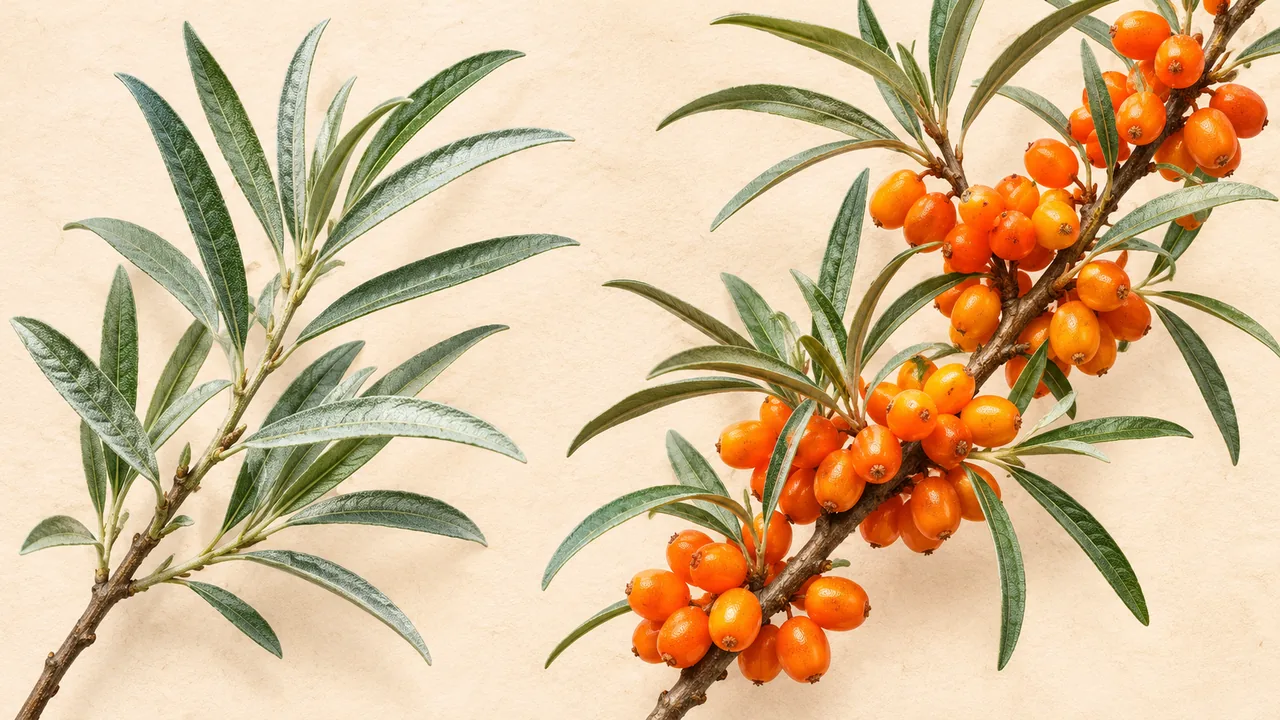
The most common reason a seaberry produces no fruit is that it is a male, or it is a female with no flowering male close enough. Sea buckthorn has separate male and female plants, only females bear berries, and pollen travels on the wind. One study traced it only about 15 m (50 ft), so plant a male within 33–50 ft of your females, at about 1 male per 6–8 females. If it has never flowered at all, the usual causes are age (named plants take 2–3 years), shade, too much nitrogen, or pruning off the older wood that carries the flower buds.
- Only female plants bear berries. A male will never fruit, no matter how old or healthy it is.
- In winter, males carry large, cone-shaped, golden-brown flower buds. Female buds are smaller and rounder.
- Wind carries the pollen. A field study found none beyond 15 m (about 50 ft) from the males.
- Named plants usually fruit 2–3 years after planting. Seedlings can’t be sexed until they flower.
- Flower buds form the summer before, on older wood. Hard pruning or browsing removes next year’s crop.
- Skip nitrogen fertilizer. It feeds leaves, not flower buds, and suppresses the root nodules that fix nitrogen.
Seaberry not producing fruit? The 8 reasons at a glance
A common complaint on gardening forums: a four-year-old seaberry, healthy and silver-leaved, that has never had a berry. Usually the plant is fine; the problem is its sex, its partner, or how it is fed and pruned. The eight causes, roughly from most to least common:
- It is a male. Sea buckthorn is dioecious: every plant is either male or female, and only females bear fruit [1][3].
- The label was wrong. You may own two males, or a different cultivar than you paid for.
- The male is too far away or downwind. Pollen moves by wind and gravity only, not bees [1].
- Male and female bloom at different times. Each female flower is receptive for only about three days [6].
- The plant is too young. Named plants from cuttings take 2–3 years to bear [1].
- Too much shade. It needs more than half a day of sun [1].
- Too much nitrogen, or a dry summer. Fertilizer pushes leaves over flower buds [8]; dry soil during fruit set cuts the crop [7].
- The fruiting wood was removed. Flower buds form on older wood, so heavy pruning or deer browsing can remove next year’s crop [2].
How to tell male from female sea buckthorn
You can’t sex a young plant by its leaves. Manitoba’s agriculture department says plant sex cannot be determined until it flowers [3], and researchers building DNA tests for sea buckthorn cite the same problem [9]. Once it is old enough to flower, check twice a year.
In winter: look at the buds
- Male: flower buds are conical and conspicuous [4]. New Mexico State University describes males as covered with large golden-brown flower buds in winter and spring [5]. Think of small cones lined up along the twigs.
- Female: buds are smaller and rounder [4]. A female that fruited may still hold old berries, which often stay on all winter [7].
The difference is obvious next to a known male and easy to misread on a lone plant.
In spring: watch the flowers
Both sexes flower, tiny and easy to miss, before the leaves open [3]. Male flowers sit in dense clusters and shed masses of dry, powdery pollen; a female flower is a single yellowish-green stigma with no pollen [6]. Tap a blooming branch over dark paper: a dusting of yellow pollen means a male.
Mislabeling happens. At the University of Wisconsin’s test plot, one cultivar did not match its catalog description, likely a labeling error [1]. Buy named plants grown from cuttings, keep the tags, and confirm sex at first bloom.
Pollination: distance, ratio and bloom timing
How close does the male need to be?
Closer than most gardeners think. In a two-year field study of wild sea buckthorn in the Himalayas, no pollen landed on traps more than 15 m (about 50 ft) from the males. Only about 60% of female flowers were pollinated even in natural stands, and the most widely spaced population did worst. The authors recommend a male within 10–15 m (33–50 ft) of every female [6].
That valley is windy, so treat 50 ft as a limit, not a target. Put the male upwind of the females [7], with no fence or building in between. A male across the street is not your female’s pollinator.
How many males?
Sources agree on roughly 1 male for every 6–8 females [1][2][7]; Manitoba says 7–12% of plants [3]. One male and one female is fine if they are close and bloom together.
Do they bloom at the same time?
Timing is tight. In the same study, males bloomed 2–3 days before females, pollen was dead within 72 hours, and a female flower was receptive for only about three days [6]. A male that finishes a week early leaves her with nothing. That is why nurseries sell matched pairs; the German male ‘Pollmix’, for example, is traditionally paired with the German female ‘Leikora’ [1]. If you mix cultivars, note bloom dates each spring.
Example scenario: two ‘Titan’ females by the back fence, a male 70 ft away by the driveway, healthy plants, almost no berries. Adding a male 15–30 ft from the females on the upwind side fixes the likely cause. Meanwhile, hand-pollinate: cut a flowering male branch and shake it over the females [4].
A lone female with a few berries? Wild sea buckthorn is a facultative apomict: some seeds can form without pollination [10]. No source shows this gives a useful crop in garden cultivars, so plan on a male.
How long until seaberry fruits?
Named plants grown from cuttings usually fruit 2–3 years after planting [1]. Seedlings take longer, and you won’t know which are female until they bloom [3][4]. A small mail-order plant set back by drought or browsing can lose a year. Three years in full sun and still no flowers? Check the site factors below.
Sun, nitrogen, water and pruning
Shade
At the University of Wisconsin test site, plants with less than half a day of sun were dead or dying within two years, and shaded lower branches on unpruned bushes stopped fruiting [1].
Too much nitrogen
Sea buckthorn fixes its own nitrogen in root nodules, and nitrogen fertilizer can reduce and delay nodulation [2]; Wisconsin’s growers advise against it [1]. Penn State Extension calls overvigor the number one reason home fruit trees fail to bear: heavy nitrogen pushes wood and leaves instead of flower buds, and lawn fertilizer nearby reaches tree roots too [8]. Long, leafy shoots and no flowers point here. Stop feeding and keep lawn fertilizer away from the root zone.
Dry soil during fruit set
Established seaberry tolerates drought, but production suffers if the soil is too dry when fruit is forming [7]. If berries shrivel or drop in a dry spell, water deeply through early and mid summer.
Pruning off the fruiting wood
Flower buds form the season before, mostly on 2-year-old wood [2][7]. A hard cutback every winter, or cutting whole bushes to harvest every year, removes next year’s flowers. Wisconsin suggests cutting fruiting branches on a two-year rotation, the time new growth needs to become fruitful [1].
Deer, birds and frost
Less likely than people assume. Rutgers rates sea buckthorn “seldom severely damaged” by deer [11], though young plants still get browsed. Birds rarely strip it; the berries usually cling on all winter [7]. Wisconsin’s growers have never lost a crop to spring freezes [1]. Their one pest note: Japanese beetles like the leaves.
Diagnosis table: symptom, likely cause, fix
| What you see | Likely cause | What to do |
|---|---|---|
| Large cone-like buds in winter; yellow pollen in spring; never any berries | It is a male [4][5] | Keep it as the pollinator. Plant named females within 33–50 ft |
| Female flowers every spring, few or no berries | No male close enough, male downwind, or bloom timing off [6] | Add a matched male upwind and close; hand-pollinate in the meantime |
| Healthy plant, 1–2 years in the ground, no flowers | Too young [1] | Wait. Named plants usually bear in year 2–3 |
| Thin growth, sparse leaves, no flowers, under trees | Shade [1] | Move it to full sun in early spring or fall |
| Long, lush leafy shoots, no flower buds | Nitrogen, including lawn feed [8] | Stop fertilizing; keep lawn fertilizer away from the root zone |
| Berries form, then shrivel or drop in summer | Dry soil during fruit set [7] | Deep watering in early and mid summer; mulch |
| Fruit only at the very top; bare lower branches | Self-shading [1] | Thin the canopy and keep plants around 6 ft |
| Flowered well before a hard cutback, nothing since | Fruiting wood removed [2] | Prune lightly; cut fruiting branches on a 2-year rotation |
Once the berries arrive, see our complete growing guide for harvest tips, then how to eat sea buckthorn berries, our juice guide and sea buckthorn tea. If you would rather buy fruit than wait, see where to buy sea buckthorn in the USA.
Frequently asked questions
Why is my seaberry not producing fruit?
Most often it is a male, or a female with no flowering male close enough. Other causes are age, shade, nitrogen fertilizer and pruning off the older wood that carries flower buds.
How can I tell a male from a female sea buckthorn?
Wait until it is old enough to flower. In winter, males have large, cone-shaped, golden-brown flower buds while female buds are smaller and rounder. In spring, a male branch releases yellow pollen when tapped; a female does not.
Do I need a male sea buckthorn to get berries?
Yes. Only females bear berries and they need wind-blown pollen from a male. Plant about 1 male per 6 to 8 females, and keep the male within about 33 to 50 feet of them, on the upwind side.
How far can a male sea buckthorn be from the female?
A field study found no pollen more than 15 meters (about 50 feet) from the males and recommended keeping a male within 10 to 15 meters of each female. Closer is better in a sheltered backyard.
How many years until sea buckthorn produces berries?
Named plants grown from cuttings usually fruit 2 to 3 years after planting. Seedlings take longer, and you cannot tell which are female until they flower.
Can a female sea buckthorn make berries without a male?
Rarely in useful amounts. Sea buckthorn can set some seed without pollination, but a reliable crop needs a flowering male nearby.
Should I fertilize sea buckthorn to get more berries?
No nitrogen. Sea buckthorn makes its own nitrogen through root nodules, and extra nitrogen, including lawn fertilizer, pushes leafy growth instead of flower buds.
- University of Wisconsin–Madison, Center for Integrated Agricultural Systems. Uncommon Fruits: Seaberry (sea buckthorn), observations from Carandale Farm. uncommonfruit.cias.wisc.edu
- Li TSC. Sea buckthorn: new crop opportunity. In: Janick J, ed. Perspectives on New Crops and New Uses. ASHS Press; 1999:335-337. Purdue University NewCROP. hort.purdue.edu
- Manitoba Agriculture. Sea buckthorn production in Manitoba. gov.mb.ca
- Trees and Shrubs Online (International Dendrology Society). Hippophae rhamnoides. treesandshrubsonline.org
- Yao S (rev.). Minor small fruit crops for New Mexico gardens. Guide H-326. New Mexico State University Cooperative Extension Service. pubs.nmsu.edu
- Mangla Y, Tandon R. Pollination ecology of Himalayan sea buckthorn, Hippophae rhamnoides L. (Elaeagnaceae). Curr Sci. 2014;106(12):1731-1736. currentscience.ac.in (PDF)
- Davison J, Riggs W. Testing seaberry as an alternative crop in Nevada. Fact Sheet FS-04-75. University of Nevada, Reno Extension; 2004. extension.unr.edu
- Penn State Extension. Home orchards: why is there no fruit on my tree? extension.psu.edu
- Zhou W, Wang Y, Zhang G, et al. Molecular sex identification in dioecious Hippophae rhamnoides L. via RAPD and SCAR markers. Molecules. 2018;23(5):1048. PubMed
- Mangla Y, Chaudhary M, Gupta H, et al. Facultative apomixis and development of fruit in a deciduous shrub with medicinal and nutritional uses. AoB Plants. 2015;7:plv098. PubMed
- Rutgers Cooperative Extension. Landscape plants rated by deer resistance (sea buckthorn: seldom severely damaged). extension.rutgers.edu
Growing conditions vary by region. For local advice on fruit plants, contact your county cooperative extension office.