
Sea Buckthorn for Vaginal Dryness: Oral vs Topical, Which Oil, and What If It Isn’t Working
A close read of the one clinical trial, why it used a seed-and-berry blend, how long to give it, why you should swallow it rather than apply it, and what to try next if nothing changes.
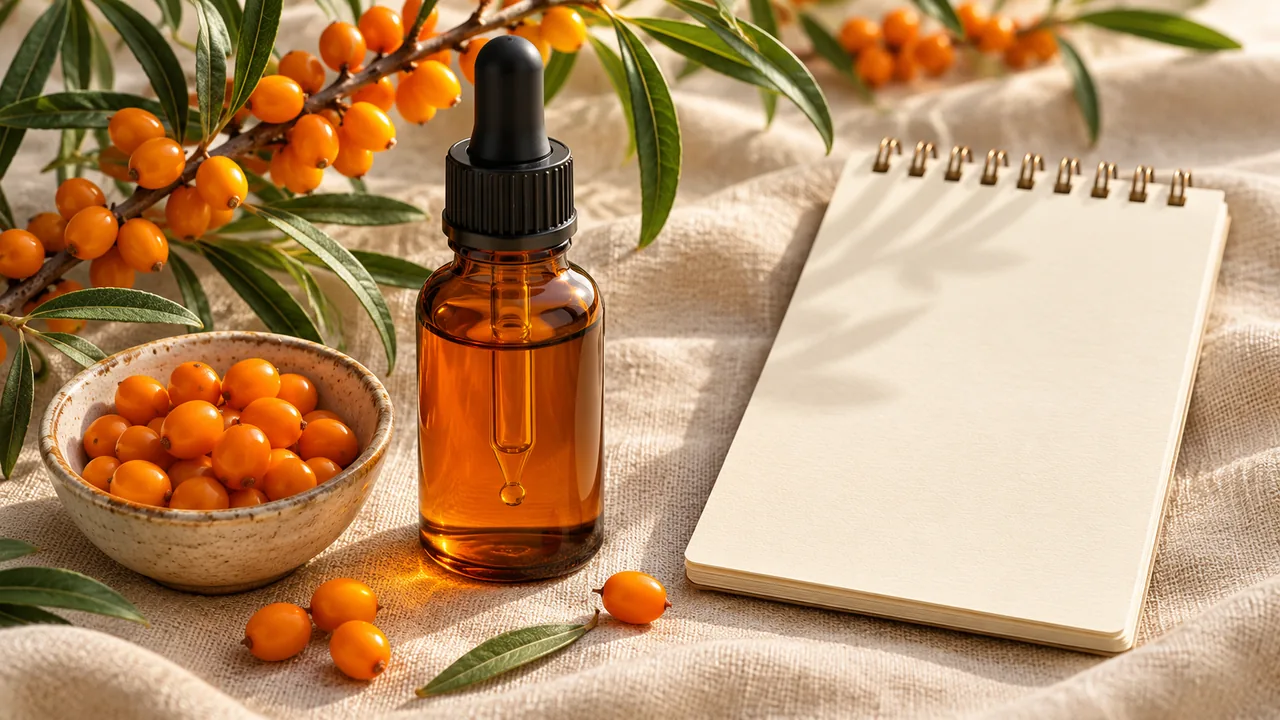
Sea buckthorn may help vaginal dryness, but slowly and modestly. In the only trial, 116 postmenopausal women took 3 g a day of a combined seed-and-berry oil (six 500 mg softgels) for 3 months. The vaginal lining improved more than with placebo (odds about 3 times higher), but the published abstract reports no clear improvement in symptoms, pH or moisture. Take it by mouth, give it 12 weeks, and if nothing changes, moisturizers and low-dose vaginal estrogen have much stronger evidence.
- One trial, 116 women: 3 g/day for 3 months improved the vaginal lining vs placebo (odds ratio 3.1). Symptom relief wasn’t reported as significant.
- How long: results were checked only at 3 months, so give it a full 12 weeks.
- Which oil: the trial used a CO2-extracted seed and berry blend, not pulp oil alone, so “only fruit oil works” is a myth.
- Swallow, don’t insert: oils weaken latex condoms, and vaginal oil use was linked with yeast in a US study.
- Slippery elm has no published studies for vaginal dryness at all.
- Moisturizers and lubricants are first-line; vaginal estrogen has the strongest evidence. After breast cancer, involve your oncologist.
The one trial: what improved and what didn’t
Nearly every claim about sea buckthorn for vaginal dryness traces back to one Finnish study from 2014 [1]. Here are the details most summaries skip.
| Study detail | What the trial did |
|---|---|
| Who | 116 women aged 55–75, at least 12 months past their last period, with vaginal dryness, itching or burning; women using estrogen therapy were excluded [1][2] |
| Dose | 3 g of oil a day, given as 6 capsules, or 6 placebo capsules [2] |
| Oil | “Combined CO2-extracted sea buckthorn seed and berry oil,” according to the lead author [3] |
| Length | 3 months; 98 women finished [1] |
| Main win | A gynecologist scored the vaginal lining. It improved more often with sea buckthorn: odds ratio 3.1 (95% CI 1.11–8.95) counting all participants [1] |
| Weaker results | Counting only women who took their capsules as directed, the effect was a non-significant trend (OR 2.9). The vaginal health index rose 0.8 points with sea buckthorn vs a 0.1-point drop with placebo (P = 0.08, not significant) [1] |
| Not reported as better | Vaginal pH, moisture and the women’s own symptom scores were measured, but the abstract reports no significant difference for them [1] |
| Who ran it | Sponsored by an oil manufacturer, with a Finnish government innovation agency as collaborator [2] |
The authors called the oil a potential option for women who can’t use estrogen [1]. Fair, but the measurable change was in the tissue a doctor sees, not clearly in how dry women felt. If you want comfort during sex next month, sea buckthorn is the wrong first tool. Our menopause dryness overview puts this trial alongside the dry-eye research.
Omega-7 for vaginal dryness: how long it takes
The honest answer is at least 12 weeks. The trial measured vaginal health only at the start and at 3 months [1], so nobody knows whether some women improve at 6 weeks or whether 6 months would work better.
A common forum complaint is “2 months and nothing.” At 8 weeks you haven’t reached the trial’s endpoint, so it’s too early to call. At 12 weeks with no change, it’s reasonable to move on (see what next).
Example routine at the trial dose
Six 500 mg softgels = 3 g. Take 3 with breakfast and 3 with dinner, since oil is absorbed better with a meal (best time to take sea buckthorn). Start with 2 a day for the first week to limit stomach upset, then build up. Put a week-12 check-in on your calendar.
Swallow or apply? Oral vs topical
The 2014 trial tested oil swallowed in capsules. That’s the only form with evidence for menopausal dryness.
Topical research is thin. In a Chinese study of 377 postmenopausal women, a compound sea buckthorn oil suppository used for 2 weeks before colposcopy (a cervical exam) improved the vaginal lining about as well as an estrogen ointment [8]. But it was a multi-ingredient product tested to make an exam easier, not to relieve dryness, and it isn’t sold in the US.
Don’t put sea buckthorn face oil, capsule contents or essential oils inside the vagina.
- Condoms: pure oils such as coconut or almond can break down condoms; use water-based or silicone-based products with condoms [10].
- Infection: in a US cohort of 141 women, those who put oils in the vagina had Candida yeast far more often (44.4% vs 5%) [9]. That study was small and can’t prove cause, but it’s a reason for caution.
- Staining and irritation: pulp oil is deep orange and stains underwear and sheets. Fragranced or “warming” products can make irritated tissue worse [10].
For local relief, use products made for vaginal use: a moisturizer on a schedule, a lubricant for sex.
Pulp, seed or blend: which oil?
Seed oil is rich in omega-6 linoleic acid (up to 42%) and omega-3 alpha-linolenic acid (20–35%). Pulp (berry) oil is dominated by omega-7 fatty acids, mainly palmitoleic acid [6].
Myth: only fruit oil has the omega-7 that helps. The trial used a combined seed-and-berry oil [3], so it can’t tell us that omega-7 is the active ingredient. The researchers credited a mix of fatty acids, vitamin E and carotenoids [3]. The only trial of purified omega-7 alone looked at skin hydration, not vaginal tissue [7]. A pulp-only or purified omega-7 product might work, but it’s untested here.
Practical pick: a seed-and-pulp (or “whole berry”) blend that lists the milligrams of sea buckthorn oil per softgel. Then do the math:
- Label says 1,000 mg oil per serving of 2 softgels: you need 6 softgels (3 servings) to reach 3 g.
- A 60-softgel bottle lasts just 10 days at that dose, so a 12-week test needs about 504 softgels.
- If your label suggests 2 softgels a day (1 g), you’re taking one-third of the trial dose.
See our capsule buying guide and cold-pressed vs CO2-extracted oil for more on extraction.
3 g a day and nothing: what next
- Check the dose. Is it 3 g of sea buckthorn oil, or of a blend where sea buckthorn is only part?
- Check the time. Under 12 weeks is too soon to judge.
- Add a moisturizer now; don’t wait. The Menopause Society says over-the-counter lubricants and moisturizers give enough relief for most women with mild symptoms [4].
- If symptoms are moderate or severe, ask about low-dose vaginal estrogen, vaginal DHEA (prasterone) or ospemifene, all effective prescription options [4]. Low-dose vaginal estrogen has the strongest evidence base [5].
- Rule out other causes such as Sjögren’s disease, which also dries the eyes and mouth [15]; guidelines diagnose menopause-related dryness only after excluding other conditions [5]. Discharge, sores or any bleeding after menopause need an exam.
Moisturizers, estrogen, slippery elm vs sea buckthorn
| Option | How it’s used | Evidence |
|---|---|---|
| Water- or silicone-based lubricant | During sex; condom-safe | Recommended for mild symptoms [4] |
| Vaginal moisturizer | On a regular schedule; many doctors favor hyaluronic acid types [10] | Recommended for mild symptoms [4] |
| Oral sea buckthorn oil | 3 g/day for 12 weeks | 1 trial; lining improved, symptoms not shown [1] |
| Slippery elm capsules | Swallowed | No studies for vaginal dryness |
| Low-dose vaginal estrogen | Cream, tablet or ring, by prescription | Strongest evidence [5] |
| Vaginal DHEA, ospemifene | Prescription | Effective for moderate to severe symptoms [4] |
Slippery elm vs sea buckthorn
Slippery elm (Ulmus rubra) is the inner bark of a North American tree. Its gel-like mucilage is used for sore throat and cough, though Memorial Sloan Kettering notes human data are lacking even for that [11]. Swallowing it for vaginal dryness is popular online, but we found no published study of that in PubMed. Sea buckthorn at least has one placebo-controlled trial. Neither replaces a moisturizer.
Branded “vaginal dryness” blends
Some supplements add vitamin E, oral hyaluronic acid or herbal extracts to sea buckthorn oil. Only the oil at 3 g a day has been tested, so check how much sea buckthorn oil a daily serving actually provides.
After breast cancer, and other safety notes
Breast cancer survivors often look hardest for a non-hormonal option, especially on tamoxifen or an aromatase inhibitor, which can bring on sudden menopause [10]. Sea buckthorn oil contains no estrogen, but it hasn’t been tested in survivors; the trial excluded women on estrogen therapy [2].
- Talk to your oncologist before starting any supplement. The Menopause Society says there isn’t enough data to confirm the safety of vaginal estrogen, DHEA or ospemifene after breast cancer, and that care should follow your oncologist’s advice [4]. ACOG has published guidance on both hormonal and non-hormonal options for survivors [12].
- Blood thinners: 5 g/day of sea buckthorn berry oil reduced platelet aggregation in 12 men over 4 weeks [13]. Check with your doctor if you take warfarin, apixaban, clopidogrel or daily aspirin, and stop 2 weeks before surgery. Use our drug interaction checker.
- Side effects: mild stomach upset is most common. In one case report, 6 months of heavy sea buckthorn intake turned a man’s skin yellow [14].
More in sea buckthorn side effects and interactions, sea buckthorn for women and omega-7 benefits and sources.
Frequently asked questions
Does sea buckthorn oil help vaginal dryness?
It may help a little. In a 116-woman trial, 3 g a day for 3 months improved the vaginal lining compared with placebo, but symptom relief was not reported as significant. Moisturizers and vaginal estrogen have stronger evidence.
How long does omega-7 take to work for vaginal dryness?
The trial measured results only after 3 months, so give it at least 12 weeks. There is no data showing results at 4 or 8 weeks.
How much sea buckthorn oil should I take for vaginal dryness?
The trial used 3 g of oil a day, which is six 500 mg softgels. Start with 2 a day with food and build up over a week.
Can I put sea buckthorn oil inside my vagina?
We advise against it. It has not been tested that way, oils can break down latex condoms, vaginal oil use was linked with more yeast in a US study, and pulp oil stains. Use a product made for vaginal use instead.
Slippery elm vs sea buckthorn: which is better for vaginal dryness?
Sea buckthorn has one placebo-controlled trial; slippery elm has no published studies for vaginal dryness. Neither is as well supported as a vaginal moisturizer or vaginal estrogen.
I've taken 3 g a day for 2 months with no change. Should I stop?
Two months is short of the 3-month trial endpoint. Add a vaginal moisturizer now, and if nothing has changed at 12 weeks, ask your clinician about prescription options.
Is sea buckthorn safe after breast cancer?
It contains no estrogen, but it has not been studied in breast cancer survivors. Ask your oncologist before starting it.
- Larmo PS, Yang B, Hyssälä J, Kallio HP, Erkkola R. Effects of sea buckthorn oil intake on vaginal atrophy in postmenopausal women: a randomized, double-blind, placebo-controlled study. Maturitas. 2014;79(3):316-21. PubMed
- Aromtech Ltd. Effects of sea buckthorn oil on mucous membranes (SBMM). ClinicalTrials.gov NCT01697085 (eligibility, dose and sponsor details). clinicaltrials.gov
- NutraIngredients. Sea buckthorn oil backed for vaginal dryness relief. August 18, 2014 (oil type as described by the lead author). nutraingredients.com
- The NAMS 2020 GSM Position Statement Editorial Panel. The 2020 genitourinary syndrome of menopause position statement of The North American Menopause Society. Menopause. 2020;27(9):976-92. PubMed
- Kaufman MR, Ackerman AL, Amin KA, et al. The AUA/SUFU/AUGS guideline on genitourinary syndrome of menopause. J Urol. 2025;214(3):242-50. PubMed
- Solà Marsiñach M, Cuenca AP. The impact of sea buckthorn oil fatty acids on human health. Lipids Health Dis. 2019;18(1):145. PubMed
- Koh YG, Seok J, Park JW, Kim KR, et al. Efficacy and safety of oral palmitoleic acid supplementation for skin barrier improvement: a 12-week, randomized, double-blinded, placebo-controlled study. Heliyon. 2023;9(6):e16711. PubMed
- Yu Y, Li Q, Cao Y, et al. A prospective study of vaginal topical pretreatment of compound sea-buckthorn oil suppository in postmenopausal women prior to colposcopy. Sci Rep. 2025;15(1):10364. PubMed
- Brown JM, Hess KL, Brown S, et al. Intravaginal practices and risk of bacterial vaginosis and candidiasis infection among a cohort of women in the United States. Obstet Gynecol. 2013;121(4):773-80. PubMed
- Breastcancer.org. Vaginal moisturizers and lubricants. Updated January 24, 2025. breastcancer.org
- Memorial Sloan Kettering Cancer Center. Slippery elm (About Herbs). Updated June 30, 2022. mskcc.org
- American College of Obstetricians and Gynecologists. Treatment of urogenital symptoms in individuals with a history of estrogen-dependent breast cancer: clinical consensus. Obstet Gynecol. 2021;138(6):950-60. PubMed
- Johansson AK, Korte H, Yang B, Stanley JC, Kallio HP. Sea buckthorn berry oil inhibits platelet aggregation. J Nutr Biochem. 2000;11(10):491-5. PubMed
- Grad SC, Muresan I, Dumitrascu DL. Generalized yellow skin caused by high intake of sea buckthorn. Forsch Komplementmed. 2012;19(3):153-6. PubMed
- National Institute of Dental and Craniofacial Research. Sjögren’s disease. Last reviewed February 2026. nidcr.nih.gov
This article is for general information only and is not medical advice. Talk to your doctor or pharmacist before starting any supplement, especially if you take medication, are pregnant or breastfeeding, or have a health condition.