
Sea Buckthorn for Acid Reflux, Ulcers & Gut Health: The Evidence
What rat, horse and human studies actually show for reflux, gastritis, ulcers and the microbiome, and why the acidic juice can cause the very heartburn people hope it will cure.
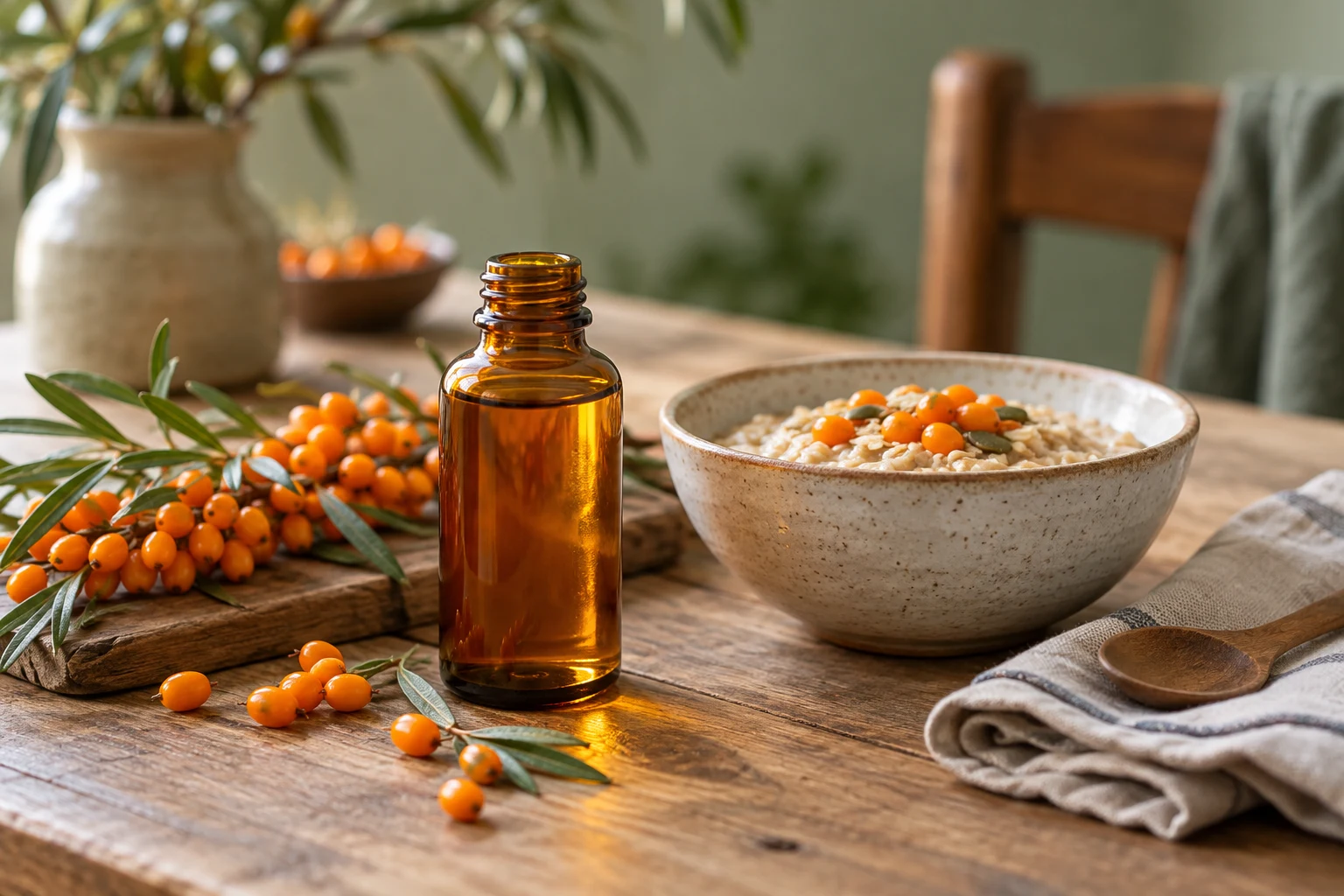
There is no good human evidence that sea buckthorn treats acid reflux, gastritis or stomach ulcers. Sea buckthorn seed and pulp oils reduced experimental ulcers in rats, and a berry supplement lowered glandular ulcer scores in 8 horses, but no modern controlled trial has tested it in people with GERD or ulcers. The juice is very acidic (pH about 2.7–2.9), so it can worsen heartburn, and large amounts of juice or oil can loosen stools in some people. Ulcers need a doctor, because most are caused by H. pylori or NSAID painkillers.
- Rats: CO2-extracted seed and pulp oils prevented and sped healing of several kinds of experimental stomach ulcer.
- Horses: a sea buckthorn berry and pulp feed supplement lowered glandular ulcer scores but did not help the more common non-glandular ulcers.
- People: no controlled trial in adults with GERD, gastritis or ulcers. A 254-person Finnish trial found the berries did not prevent digestive tract infections.
- Microbiome benefits come from mouse colitis models and lab work, not human trials.
- Sea buckthorn juice has a pH of 2.7–2.9, and acidic foods are common reflux triggers. Try it with food, diluted, or skip it.
- Black or bloody stools, vomiting blood, or severe stomach pain need medical care right away.
Sea buckthorn for acid reflux
Sea buckthorn (Hippophae rhamnoides) oil has a long folk reputation for soothing the lining of the stomach and gut, and a 2025 review describes its traditional use for digestive disease in China [1]. For acid reflux and GERD specifically, though, we found no published human trial.
The bigger issue is that sea buckthorn juice is strongly acidic. Finnish testing of seven varieties found a pH of 2.7 to 2.9 and 3.1 to 5.1 g of fruit acids (mainly malic and quinic acid) per 100 mL [2]. The National Institute of Diabetes and Digestive and Kidney Diseases (NIDDK) lists acidic foods such as citrus fruits and tomatoes, along with high-fat foods, among common reflux triggers [3].
- Juice, berry tea and puree are the forms most likely to aggravate reflux.
- Oil capsules are not acidic, but they are fat. If fatty meals set off your heartburn, take them with a lighter meal, not at bedtime.
- NIDDK suggests finishing meals at least 3 hours before lying down if reflux strikes at night [3].
If you have frequent heartburn, NIDDK’s recommended options include losing weight if needed, raising your head 6–8 inches during sleep, quitting smoking, changing your diet, and medicines such as antacids, H2 blockers and proton pump inhibitors [20]. See a doctor if over-the-counter medicines and lifestyle changes aren’t helping, or if you have chest pain, trouble or pain swallowing, persistent vomiting, or unexplained weight loss [4].
Sea buckthorn oil for stomach ulcers and gastritis
This is where most of the research sits, and nearly all of it is in animals.
| Study | What was tested | Result | Evidence |
|---|---|---|---|
| Rats, 2002 [5] | CO2-extracted seed and pulp oils by mouth, 3.5–7 mL per kg body weight a day | Fewer ulcers from stress and reserpine; lower ulcer index after pylorus ligation; faster healing of acetic acid ulcers | Animals |
| Rats, 2001 [6] | Hexane extract of sea buckthorn | Protected against ulcers from indomethacin (an NSAID) and stress | Animals |
| Rats, 2007 [7] | Procyanidins from sea buckthorn bark | Smaller acetic acid ulcers at 7 and 14 days, dose-dependent | Animals |
| 8 horses, crossover, 5 weeks [8] | Commercial berry and pulp emulsion, 4 oz (35.6 g berries and pulp) twice daily with feed | Lower glandular ulcer number and severity; no effect on non-glandular ulcers | Animals, controlled |
| Lab dish, 2025 [9] | Organic acids extracted from sea buckthorn | Inhibited H. pylori growth at 10 mg/mL and reduced its virulence genes | Lab only |
| People with ulcers | — | A 1987 Russian-language clinical paper on sea buckthorn oil in peptic ulcer is indexed without an abstract [10]; we found no modern controlled trial | None we can assess |
The horse study, run at Louisiana State University, is the most careful of these. Eight horses got the supplement or nothing for 4 weeks, then a week of on-and-off feed withholding to provoke ulcers. Non-glandular ulcers got worse in all horses regardless of treatment, while glandular ulcers were fewer and milder in the supplemented horses [8]. Our guide to sea buckthorn for dogs, cats and horses covers animal use.
Don’t self-treat an ulcer. The most common causes of peptic ulcers are H. pylori infection and NSAIDs such as aspirin, ibuprofen and naproxen, and both need proper treatment. Get medical help right away for black or tarry stools, red or maroon blood in stool, vomit with blood or that looks like coffee grounds, sudden severe stomach pain, dizziness or fainting [11].
Animal vs human evidence
Rat results sound impressive until you convert the dose. Researchers scale doses between species by body surface area; for rats, you divide the mg/kg (or mL/kg) dose by about 6.2 to get a human-equivalent dose [12].
Worked example: the higher rat dose was 7 mL of oil per kg a day [5]. Divided by 6.2, that is about 1.13 mL/kg. For a 154 lb (70 kg) adult, that is about 79 mL a day, more than 5 tablespoons of oil. Human sea buckthorn oil trials have used 2–5 g a day, roughly 2–5.5 mL, or about ½ to 1 teaspoon [13][14].
That gap doesn’t prove sea buckthorn is useless for the stomach, but it means the rat findings can’t be read as a dose for people. The human digestive data we do have are thin:
- In a double-blind Finnish trial, 254 healthy adults ate sea buckthorn berries or a placebo product. There was no difference in digestive tract infections (or colds) [15].
- In a Chinese trial, 120 children with functional dyspepsia (chronic indigestion) got sea buckthorn, the stomach-emptying drug domperidone, or both for 8 weeks. Sea buckthorn groups had faster stomach emptying and higher appetite hormones [16]. There was no placebo, and it hasn’t been repeated in adults.
Sea buckthorn gut health and the microbiome
“Gut health” claims for sea buckthorn mostly come from animal colitis models. In mice with chemically induced colitis, a sea buckthorn berry extract eased inflammation and protected the gut lining, and the benefit depended on gut bacteria: it raised a butyrate-producing species, and the effect disappeared when those bacteria were wiped out with antibiotics [17]. A 2025 review describes anti-inflammatory, microbiota-regulating and anti-H. pylori effects across cell, animal and human studies [1], but we found no randomized trial showing a gut benefit in people.
Mouse colitis is not the same as ulcerative colitis or Crohn’s disease in people. If you have inflammatory bowel disease, don’t swap or reduce your prescribed treatment; ask your gastroenterologist before adding any supplement.
Can sea buckthorn cause diarrhea or heartburn?
Yes, both are possible. We found no trial that measured how often it happens, but each form has an ingredient that can do it:
| Form | Possible problem | Why |
|---|---|---|
| Juice, puree, berry tea | Heartburn | pH 2.7–2.9 [2]; acidic foods are common reflux triggers [3] |
| Juice, especially sweetened | Loose stools | Fructose in fruit juice can cause diarrhea in people who don’t digest it well [18]; pure juice has 1.9–7.1 g sugar per 100 mL [2] |
| Oil, large doses | Loose stools, reflux | High-fat foods are reflux triggers [3]; take oil with meals and build up slowly |
| Juice plus vitamin C pills | Diarrhea, nausea, cramps | Too much vitamin C causes these; the adult upper limit is 2,000 mg a day [19] |
If sea buckthorn gives you loose stools, cut back or stop. See a doctor right away for diarrhea lasting more than 2 days, high fever, six or more loose stools a day, black or bloody stools, or signs of dehydration [18].
If you want to try it
Our sea buckthorn dosage calculator provides an overview of amounts by product form; it does not establish a treatment dose for reflux or ulcers.
For a healthy adult with an occasional sensitive stomach, food amounts are low risk. A sensible approach:
- Start with oil capsules, not juice, if acidity bothers you: 1 softgel (500 mg) with dinner for a week, then 1 with breakfast and 1 with dinner.
- If you prefer juice, dilute 1 oz (30 mL) of pure juice in a full glass of water and drink it with a meal, never right before bed.
- Keep a simple log for 2 weeks: dose, time, and any heartburn or stool changes. Stop if symptoms get worse.
- Don’t use it in place of acid-reducing medicine or H. pylori treatment your doctor has prescribed.
Talk to your doctor first if you take a blood thinner, have an active or bleeding ulcer, are pregnant or breastfeeding, or have surgery within 2 weeks; our drug interaction checker covers specific medicines. Timing tips are in the best time to take sea buckthorn, and the full safety picture is in side effects and interactions. If your interest is liver health, see is sea buckthorn good for the liver and kidneys.
Frequently asked questions
Is sea buckthorn good for acid reflux?
There are no human trials showing it helps acid reflux. Sea buckthorn juice is very acidic, with a pH around 2.7 to 2.9, so it may make heartburn worse. Oil capsules taken with a meal are less likely to bother you.
Does sea buckthorn oil heal stomach ulcers?
Only in animals so far. Seed and pulp oils reduced experimental ulcers in rats, and a berry supplement lowered glandular ulcer scores in horses. There is no modern controlled trial in people, and ulcers need medical treatment.
Can sea buckthorn help gastritis?
It has not been tested in people with gastritis. Lab studies show its organic acids inhibit H. pylori, a common cause of gastritis, but that is far from proof it works in the stomach. See a doctor for testing and treatment.
Can sea buckthorn cause diarrhea?
It can. Fruit sugars in juice, large doses of oil, and very high vitamin C intakes can all loosen stools. Cut back if it happens, and see a doctor if diarrhea lasts more than 2 days.
Is sea buckthorn good for gut health?
Mouse studies suggest it may calm colitis by changing gut bacteria, but this has not been shown in human trials. A 254-person trial found sea buckthorn berries did not prevent digestive tract infections.
Can sea buckthorn juice cause heartburn?
Yes, in some people. Its pH is about 2.7 to 2.9, and acidic foods are common reflux triggers. Dilute it and drink it with a meal.
Can I take sea buckthorn with omeprazole or other reflux medicine?
We found no known interaction, but sea buckthorn should not replace prescribed medicine. Ask your doctor or pharmacist, especially if you also take a blood thinner.
- Dong W, Tang Y, Qiao J, Dong Z, Cheng J. Sea buckthorn bioactive metabolites and their pharmacological potential in digestive diseases. Front Pharmacol. 2025;16:1637676. PubMed
- Tiitinen KM, Hakala MA, Kallio HP. Quality components of sea buckthorn (Hippophae rhamnoides) varieties. J Agric Food Chem. 2005;53(5):1692-9. PubMed
- National Institute of Diabetes and Digestive and Kidney Diseases. Eating, Diet, & Nutrition for GER & GERD. niddk.nih.gov
- National Institute of Diabetes and Digestive and Kidney Diseases. Symptoms & Causes of GER & GERD. niddk.nih.gov
- Xing J, Yang B, Dong Y, et al. Effects of sea buckthorn (Hippophaë rhamnoides L.) seed and pulp oils on experimental models of gastric ulcer in rats. Fitoterapia. 2002;73(7-8):644-50. PubMed
- Süleyman H, Demirezer LO, Büyükokuroglu ME, et al. Antiulcerogenic effect of Hippophae rhamnoides L. Phytother Res. 2001;15(7):625-7. PubMed
- Xu X, Xie B, Pan S, et al. Effects of sea buckthorn procyanidins on healing of acetic acid-induced lesions in the rat stomach. Asia Pac J Clin Nutr. 2007;16 Suppl 1:234-8. PubMed
- Huff NK, Auer AD, Garza F Jr, et al. Effect of sea buckthorn berries and pulp in a liquid emulsion on gastric ulcer scores and gastric juice pH in horses. J Vet Intern Med. 2012;26(5):1186-91. PubMed
- Gao Q, Ma Y, Liu H, Wang S. A potential anti-Helicobacter pylori strategy: exploring the antibacterial mechanism of organic acids in sea buckthorn (Hippophae rhamnoides L.). Microbiol Res. 2025;296:128133. PubMed
- Tsimmerman IaS, Mikhaĭlovskaia LV. [Effect of sea buckthorn oil on various pathophysiologic mechanisms and the course of peptic ulcer]. Klin Med (Mosk). 1987;65(2):77-82. Russian. PubMed
- National Institute of Diabetes and Digestive and Kidney Diseases. Symptoms & Causes of Peptic Ulcers (Stomach Ulcers). niddk.nih.gov
- Nair AB, Jacob S. A simple practice guide for dose conversion between animals and human. J Basic Clin Pharm. 2016;7(2):27-31. PubMed
- Larmo PS, Järvinen RL, Setälä NL, et al. Oral sea buckthorn oil attenuates tear film osmolarity and symptoms in individuals with dry eye. J Nutr. 2010;140(8):1462-8. PubMed
- Yang B, Kalimo KO, Mattila LM, et al. Effects of dietary supplementation with sea buckthorn (Hippophaë rhamnoides) seed and pulp oils on atopic dermatitis. J Nutr Biochem. 1999;10(11):622-30. PubMed
- Larmo P, Alin J, Salminen E, Kallio H, Tahvonen R. Effects of sea buckthorn berries on infections and inflammation: a double-blind, randomized, placebo-controlled trial. Eur J Clin Nutr. 2008;62(9):1123-30. PubMed
- Xiao M, Qiu X, Yue D, et al. Influence of Hippophae rhamnoides on two appetite factors, gastric emptying and metabolic parameters, in children with functional dyspepsia. Hell J Nucl Med. 2013;16(1):38-43. PubMed
- Song Z, Qiao Z, Liu J, et al. Sea buckthorn berries alleviate ulcerative colitis via regulating gut Faecalibaculum rodentium-mediated butyrate biosynthesis. Phytomedicine. 2025;139:156490. PubMed
- National Institute of Diabetes and Digestive and Kidney Diseases. Symptoms & Causes of Diarrhea. niddk.nih.gov
- NIH Office of Dietary Supplements. Vitamin C: Fact Sheet for Consumers. ods.od.nih.gov
- National Institute of Diabetes and Digestive and Kidney Diseases. Treatment for GER & GERD. niddk.nih.gov
This article is for general information only and is not medical advice. Talk to your doctor or pharmacist before starting any supplement, especially if you take medication, are pregnant or breastfeeding, or have a health condition.